Construction Law, Radio/Media
Building the Okanagan: Construction Contracts, Liens, and Prompt Payment Explained
October 26, 2026 by Clay Williams
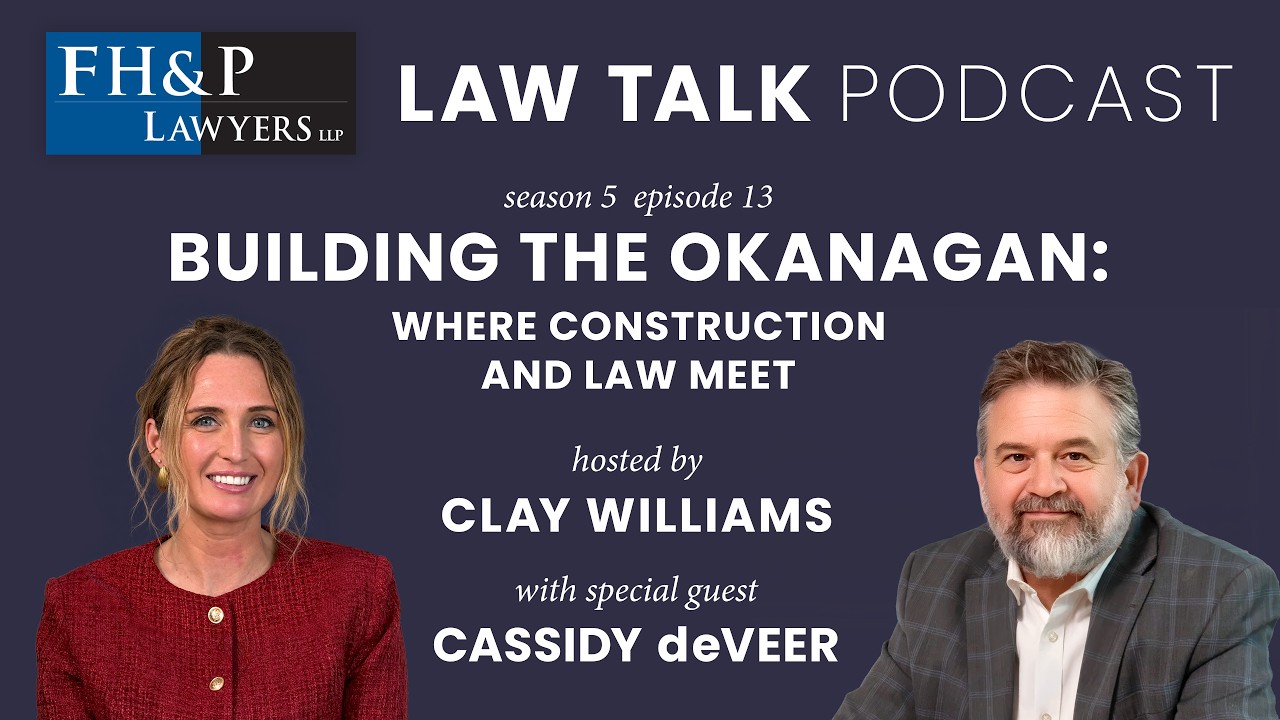
In this episode of FH&P Lawyers Law Talk, Clay Williams speaks with Cassidy deVeer, Executive Officer of the Canadian Home Builders’ Association (CHBA) Central Okanagan. Cassidy also co-hosts the One Foot Off Center, a regional podcast and media series that covers politics, growth, housing, and community issues in the Okanagan and Kelowna, British Columbia.
Cassidy and Clay discuss why fewer homes are being built in the region, what is driving up the cost of construction, why residential builders and homeowners need proper contracts, and what proposed prompt payment legislation and Builders Lien Act changes could mean for the industry.
What Does the Canadian Home Builders’ Association Do?
There’s a national and a provincial association, as well as local chapters. The Central Okanagan chapter covers the area from Peachland to Enderby, with a main focus on West Kelowna, Kelowna, Lake Country, and Vernon. The executive officer role is a CEO type of position.
The association focuses on three main areas. The first is education. The second, and probably the number one topic, is advocacy for residential construction and home ownership. The third is networking and relationship building, because any construction project will have 63 different companies working on it on average, plus all the employees within those companies. Every project is a group project, so having a strong network and building those relationships is pivotal in the association and the industry.
Does the Association Focus on Home Building Rather Than Commercial Projects?
Yes. The focus isn’t big commercial projects; it’s home building and renovation projects. On average, members build fewer than five homes a year. They’re smaller companies with an average of nine employees, and small businesses for the most part.
Why Aren’t More Homes Being Built Right Now?
If you drive around Kelowna, you won’t see a lot of homes being built. What you will see are massive projects and multi-family dwellings, more in the commercial sphere. There are sky-high unemployment rates in the construction community, and companies are reporting that most of their work is in Vernon or Revelstoke. One flooring installer couldn’t remember the last time they did a job in Kelowna. The slowdown is hitting Kelowna even more than some of the smaller communities.
What Is the Biggest Issue Facing Members Right Now?
An overall lack of work. Renovators are still pretty busy, and it is challenging for a homeowner to find a high-quality renovator. But for single family homes, fourplexes, anything missing middle, carriage homes and all of that, it’s just so expensive to build right now.
There’s also a lot of uncertainty, and uncertainty breeds hesitation. Many people are waiting to see the outcome of municipal and provincial elections. There’s money sitting on the sidelines, waiting for some certainty about what’s happening. Many people also remember what happened the last time there was scarcity, when people were worried about tariffs and trying to order materials in.
Is a Lack of Land Driving the Shift to Multi-Family Builds?
There are definitely lots for sale. Whether they are the size people want or in the location people want could be up for discussion, but there’s land available. The problem is that the cost to build and the price a home can sell for aren’t aligning.
Some builders have said that even if the land was free, their project still couldn’t move forward. Land and land prices aren’t the biggest challenge right now. It’s the overall cost of delivery compared to what you can sell a home for.
What Is Driving Up the Cost of Building a Home?
It’s death by a thousand cuts. On average across Canada, 30% of the cost of a home is government fees, charges, and taxes. That’s a third of it. Housing is taxed like cigarettes and alcohol.
When you look at the GDP of housing in Canada, it’s a huge chunk of it. The building industry is 10 times the size of the auto industry, but it never gets bailouts. If the building industry got a bailout, people would lose their minds, but it happens in the auto industry all the time.
Do People Still Want to Own a Single-Family Home?
There doesn’t seem to be a lot of political will right now for single-family dwellings, but the need and want are still there. The dream of owning a home hasn’t gone away.
The CHBA’s national office hired Abacus Data to conduct a poll, and the result was in the high 80s, in percent, of people under the age of 45 still wanting to own a home. However, the number of people who believed that was realistic is pretty low. Some younger people are giving up entirely, asking why they should save towards a house they’ll never afford.
What Federal Issues Are Creating Barriers to Home Ownership?
Federally, it’s mortgage laws. Mortgage laws are a massive barrier to home ownership for first-time home buyers. Stress tests have been a concern ever since they were put in.
Some people were forced to pick a variable rate mortgage at a lower amount, and when mortgage rates skyrocketed, they were paying far more. Ideally, they would have signed onto a fixed rate, but they couldn’t, because it was slightly higher than what they qualified for.
There are lots of things like that which don’t make sense. Canadians are allowed to have 10-year mortgages, but nobody has them, for a number of reasons. Mortgage laws need to change.
The down payment is another massive challenge. Instead of Build Canada Homes, if that money had gone into an interest-free down payment loan program, there could have been many more first-time home buyers, much more home ownership, and far less bureaucracy created.
Why Isn’t the Cost of Construction Going Down?
Overall, it’s the cost of delivery. The cost of construction isn’t going down. People ask all the time, “Things are slow. Are costs going down?” No, they’re not, because people still have to pay their rent. They still have to buy groceries. You can’t work for less when all of your costs are higher. And materials just keep increasing.
Are More Families Choosing Generational Living?
Yes, and you’ll see more of it. Families are choosing to live together, with parents moving into the basement so the kids and grandkids can have the main house, because the parents don’t need that much space. It’s about working together to own a home as a group. Another option is a carriage house, with a swap as you get older.
These arrangements can get complicated when it comes to leaving things in your Will, and that’s when you need to see FH&P Lawyers.
Why Isn’t There a Standard Residential Construction Contract?
One issue we see at FH&P Lawyers is the lack of a standard contract. In the commercial sphere, the CCDC standard contract means people know what to expect. In the residential world, there is no standard, and you wouldn’t believe some of the contracts people have built houses on. The CHBA has a standard contract, but there hasn’t been widespread adoption of a standardized contract for house building or renovations.
There are a number of reasons for this, but at least having a contract is a good step. According to BC Housing, a number of people build homes without any contract at all. It’s a handshake. When you’re spending $1,000,000 and you shake hands, that is mind-blowing.
What Do Inadequate Residential Construction Contracts Leave Out?
Usually, it’s some kind of contract the builder put together, and it’s completely inadequate. It doesn’t define scope. It doesn’t define dispute resolution. It doesn’t address builders lien holdbacks. It doesn’t take draws into consideration if you’re using mortgage financing. And it leads to disputes.
The takeaway: if you are a residential builder or renovator, get a proper construction contract. If you’re an owner, have FH&P Lawyers review it, because we see a lot of contracts that just aren’t adequate.
“If you are a residential builder or a renovator, get a proper contract. And if you’re an owner, you better get us to review it.”
Clay Williams, FH&P Lawyers
How Do Lenders and Payment Structures Affect Residential Contracts?
Different banks have different requirements, so it depends on who’s lending you the money. Lenders have their own terms they want included as well. On any custom project, payment timelines vary from project to project.
If you’re using CMHC lending, there’s a whole other process. There are also different ways to charge for management, such as a fixed fee or cost plus. There are a lot of variables.
Are Stipulated Price Contracts Still Used for Home Building?
We haven’t seen many stipulated price contracts for building a house lately. That approach is pretty tough nowadays.
The CHBA’s national website does offer a few price escalation clauses for situations like a drywall tariff. The Canadian Construction Documents Committee (CCDC) has escalation clauses in the commercial world, but there’s no equivalent standard in residential.
What Happens When a Homeowner and Builder Disagree?
A dispute can be as simple as the homeowner saying the work isn’t up to standard and the builder saying it is. Right now, the only tool a homeowner has is to say, “I’m not going to pay you,” and the only tool a builder has is to file a lien.
That isn’t very satisfactory. You’re left with a home partly built with warranty issues and a lien that needs to be dealt with. Filing a lien may or may not provide the builder satisfaction, especially if you’re dealing with a $50,000 or $20,000 lien.
Many people don’t realize that you’re supposed to enforce a lien in Supreme Court. You can’t go to small claims court. It’s very tough and very expensive, and you’ll need FH&P Lawyers. New legislation, prompt payment, might help. Maybe.
What Is Prompt Payment Legislation?
Prompt payment legislation has been working its way through the government for quite a while and has already been introduced in many other jurisdictions. It sets out timelines by which things must be paid or a dispute must be raised. It also provides a third-party arbiter, intended to be free or low cost, to keep the project moving rather than letting it break down into “Get off my property, I’m filing a lien.”
In the residential world, it’s going to be a big shock, because it codifies much of what’s already in the commercial world. Commercial projects have a payment certifier, but residential projects don’t. If it comes through, it’s going to be a big deal.
Where Is Prompt Payment Legislation At Now?
It’s a matter of seeing what happens with the election. Most recently, it was moving towards being introduced. It was expected in October, but because the election was called, that changed. Overall, the industry is supportive of being paid on time and having those processes in place.
Could the Builders Lien Act Have Solved These Issues Instead?
From the industry’s perspective, the changes could have been made to the Lien Act instead. The BC Law Society spent a lot of time reviewing the Lien Act and made a lot of recommendations. Prompt payment has a great name and a great ring to it, but the issues the industry faces could have been handled through the Lien Act. Instead, prompt payment now sits on top of it.
The draft legislation does modify the Lien Act somewhat, including getting rid of Shimco liens.
Why Is the Prompt Payment Period 28 Days?
It was selected because the UK picked it, and no one will explain why 28 days was chosen, since it’s not even a calendar month.
Who Pushed for Prompt Payment Legislation?
It has worked in other jurisdictions, and it was the commercial associations that pushed for it. It won’t be a big deal for them, since it’s basically a codification of what they already do.
How Will Prompt Payment Affect Small Builders and Renovators?
Not everyone has a sophisticated accounting department. Think of a renovator who does most of their work out of their truck and runs most of their business by email on their phone. It’s a lot more paperwork for them.
It won’t be a challenge for a business with an accounting department or a whole team. But a bookkeeper might have 15 different accounts, and the 28 days starts when you receive every separate invoice, so you have to track the date of receipt of every invoice. The residential industry still sees handwritten invoices from a notepad, the carbon copy kind from Staples. That’s going to be challenging.
It’s also unclear whether homeowners who do their own projects will be held to these standards. Tracking all of that would be quite complicated for a homeowner.
As a homeowner, you’d need to ask yourself: Is this an approved invoice? Am I going to challenge it? You may have only around 15 days to do so. It’s going to be a big change for homeowners. Many builders build a few houses a year, or fewer, and this can get them into trouble. There are best practices and practical ways to do it, and we’re always encouraging clients to use change orders. In real life, though, if you’re on site, you do what needs to be done and hope for the best. For a small business, this is going to put more cost into the project.
Can Homeowners and Contractors Still Negotiate Their Own Payment Timelines?
Prompt payment takes away your ability to negotiate your own payment timeline. Say a homeowner doesn’t have the money to pay for a fence and shed right now and asks the contractor if they can pay a certain amount over eight months. You negotiate that, and maybe you have a wonderful contract. Prompt payment takes away that ability.
It completely removes it. You could have that agreement, but it can’t override the prompt payment requirements. The contractor could change their mind, send an invoice, and you’d have to pay it within 28 days.
“You could have that agreement, but it can’t override the prompt payment requirements.”
Cassidy deVeer, CHBA Central Okanagan
That’s a concern, because you should always be able to contract and make an agreement between the two parties, whether it’s holding off on one part, doing another part now, or wanting a nicer standard for your deck. The same goes for a contractor who would rather keep working than sit at home and is willing to accept a payment arrangement.
What Did the Association Advocate for Instead?
The association advocated to keep prompt payment under a certain dollar amount. It also pointed out that the worst payer is the government, so the rules should start with government contracts. Oddly, Alberta is believed to have removed the government from having to comply, even though government is the biggest holdback when it comes to getting trades paid on infrastructure projects.
The approach should have been to start there and make sure it works. It could have been done in commercial first. Ideally, it would be phased in and brought into residential at a later date, or applied to projects under $20 million or something similar. In construction, it’s common for something to be applied to the entire industry, even though the businesses are vastly different.
Some structure in the residential sphere would be good. Prompt payment has reportedly worked in other jurisdictions, but much of that feedback comes from those with political clout, which are the big builders in the commercial world.
What Changes to the Builders Lien Act Would Help?
The 45-day lien period isn’t long enough. If you invoice monthly, and you’re waiting on your client to invoice their clients or waiting on a draw, 45 days goes by very fast.
This is especially true if you have to reach a certain stage, like finishing drywall or completing the envelope, depending on the draw schedule. The recommendation was to change it to 60 days.
There are a number of changes like that which could have simply been made. More people also need to be comfortable putting liens on. It shouldn’t be such a scary thing to do, and it’s not a ton of work to put a lien on.
Should Contractors Be Quicker to File Liens?
In the old days, a person had to go to a lawyer to put a lien on. Now, anybody can do it themselves, and we’re seeing a lot of ridiculous liens. There’s no gatekeeper asking whether it’s really in your interest to file a lien for $3,000. Those liens create havoc in getting money out of a project, or in selling a project, if it’s closing tomorrow, and a lien suddenly gets put on.
It’s often not in a subcontractor’s interest to put a small lien on. They’re not going to enforce it, and if there’s no financing, people will just wait it out.
Liens for $60,000 or $100,000 make a lot more sense. But small liens are very disruptive, and without the gatekeeper function lawyers used to have, they’re creating problems. It’s often a subcontractor brought in at the last minute who gets into an argument and files a lien for an excessive amount. We’ve seen it over and over again.
Another change that could have helped is allowing a lien to be enforced in small claims court. Right now, enforcement is priced out. A Supreme Court action just isn’t realistic for a $20,000 lien.
Residential construction in the Okanagan is facing real pressure, from rising costs and uncertainty to contracts that do not protect either side. With prompt payment legislation and possible Builders Lien Act changes on the horizon, builders, renovators, and homeowners all have reason to understand their rights and obligations before a project starts.
If you are building, renovating, or dealing with a payment dispute or lien, a properly drafted and reviewed contract can help prevent problems before they begin. Reach out to us for a consultation, and our construction law team can help you out.
Disclaimer: This material is provided for informational purposes only and should not be construed as legal advice on any subject matter. Consult with a qualified lawyer for advice on specific legal issues.