Business Formation, Corporate and Business Law, Corporate Services, Radio/Media
Incorporation 101: When It Makes Sense to Incorporate Your Business
December 30, 2025 by Clay Williams, Nancy Ling
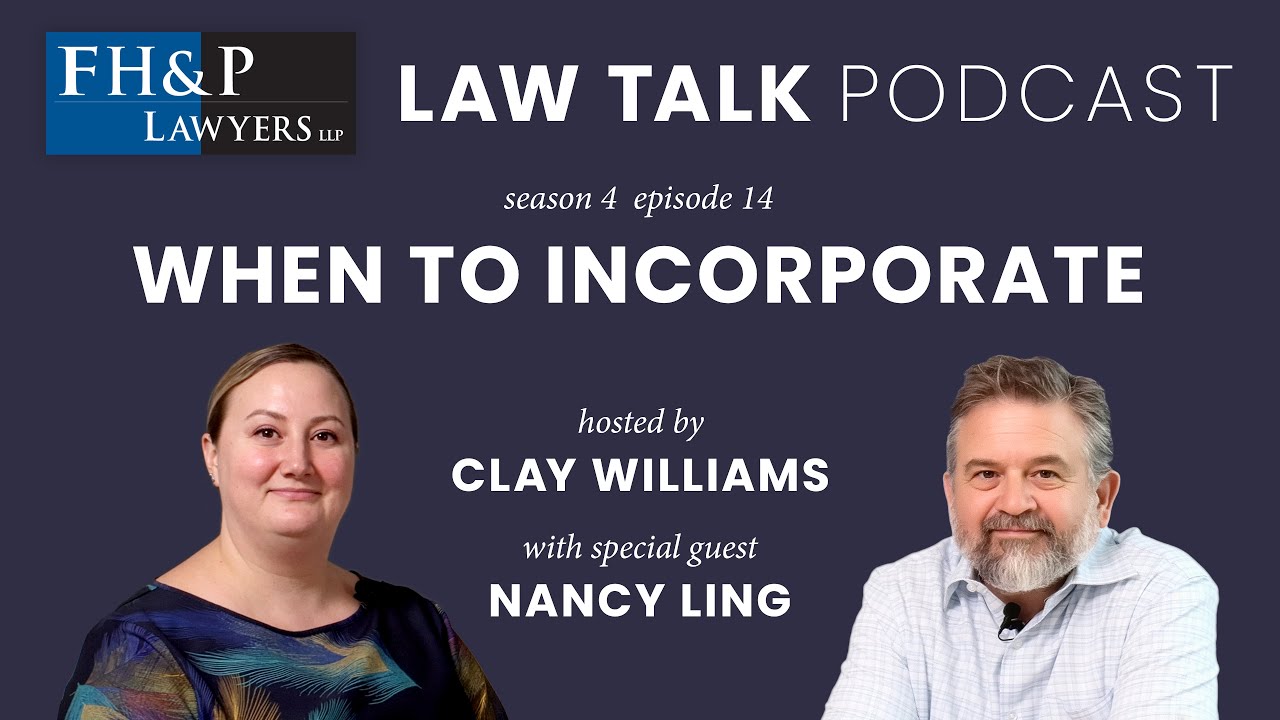
Incorporating can feel like a simple step, but the timing and setup can affect taxes, liability, and future growth. In this episode of FH&P Lawyers’ Law Talk Podcast, host Clay Williams sits down with Nancy Ling to answer the question clients ask all the time: When should I incorporate? They cover common triggers like surplus profit, bringing in investors or employees, and managing risk, plus why DIY online incorporations often miss key steps like issuing shares and keeping proper records, and how a shareholders' agreement can prevent expensive disputes later on.
Clay: Hello, and welcome to another edition of FH&P Lawyers Law Talk. I'm Clay Williams, the partner at FH&P Lawyers, and I've got a great guest, a repeat guest with me today, a performance guru and somebody who's done this before: Nancy Ling. Welcome, Nancy!
Today's topic is a question we get a lot from our clients. When to incorporate. Should I incorporate now? And so, Nancy, why don't we get you to go on with your first topic: When?
When Should You Consider Incorporating Your Business?
Nancy: Well, there are a lot of different factors that go into making the decision, but one of the main things, a good thing, is if you're making enough profit that it makes sense. If your business is earning more money than you need to cover your expenses and your living expenses every year, you've got a surplus of money.
You want to invest it back into the business. It's probably time to start talking about incorporating. So you've got too much money. That's a good problem to have. That's a good time to look into it. There are other factors to consider, though. Maybe you want to bring other parties, partners, or investors into the business with you. And when I say partners in this context, I'm still talking about a company, not a partnership.
But maybe you want to bring in some of your employees, give them a little skin in the game, give them some shares, some stock options. Maybe you have a true founding business partner with you that you want to bring in, and you want to formalize the arrangement. Maybe, if it's not on the positive side, if you've just got too much money you don't know what to do with, maybe you're in a high-risk industry, and you're a little bit worried about exposure or liability, and you want to create a little bit of a buffer. You want a little bit of protection from risk and liability. So that might be a good time to consider incorporating as well.
Clay: Yeah, I always told my clients, if there's money, it's probably a good time to look into that because there are still some tax advantages to incorporating. And so that's always good to look at. I think you're going to talk a little bit in one of your five-word headings here about how liability has historically been one of the reasons to incorporate.
Incorporating for Protection From Risk
Nancy: Yeah. Because an incorporation is an artificial legal entity. And it's the corporation that takes the contract. It's the corporation that presumably takes the lawsuits. The company is a separate person. It becomes its own taxpayer. If a customer is dealing with the company and they have an issue with the company, their remedies, their recourses are with the company, and you, as a personal individual, or even as a shareholder, you're not necessarily liable for the actions of the company.
It's a little bit different for directors. If you are the directing mind of the company and you're going off script, you're committing fraud and all these crimes, that's not going to insulate you from too many things, but you're not going to do that.
Clay: Right, one of the things I wanted to talk about, too, is with respect to the liability. Liability is very common. A very common structure that I see is actually two companies. And that gives you an additional buffer of liability.
Nancy: So again, the problem with having too much money is that if you're making a lot of profit and you're leaving all of that money in your operating company, and something goes wrong, we don't have control over all the outside factors. And maybe your company has opened up to a lawsuit.
If that company is sitting on $1 million cash and they sue you for $1 million cash, that company has got to pay $1 million cash (if it's a successful loss).
Clay: Oh, so there are lots of companies that keep that operator quite lean, and everything's in the holdco. That's one of the things. Now, what about privacy? Privacy, I think, used to be bigger than it is. But because of some of the more recent things that have happened, it's less. But it's still there.
Holding Companies: Protecting Money Left in the Business
Nancy: Yeah. There were a lot of people who, obviously, as you still should, you're going to spend some time and thought into creating your image, your brand, your name, and all of that. But they wanted that brand and the company to be at the forefront in the public eye. And people wouldn't necessarily know who the shareholders are, who the directors and officers are. We do have a corporate registry where it's public filings, who the directors of a company are, directors and officers, if you have officers.
Your shareholders were private before. That used to be a great benefit of a corporation. We called it the corporate veil. Our current government is very concerned about the transactions that happened in the shadows and how they're affecting our land title market and our business market. And so they've created all these transparency obligations. So there are now requirements on the corporate end and on real estate to disclose your shareholders.
Privacy and What the Public Can See
Clay: So, to everybody?
Nancy: No, not necessarily. So there is a public registry that we call the Land Owner Transparency Registry. So if your company is buying land now, you have to disclose certain interest holders. So if they've got a certain threshold, they'd have to look this up again. I think it's over 10% interest in the value or vote, or it's way more complicated than indirectly. It says if they control the company, you have to disclose them and where they reside.
So if you think you're dealing with the local mom and pop, and you do a search in the Land Owner Transparency Registry and see that it's Igor from Russia who is an interest holder, you might not be dealing with the local entity,
Clay: But shareholding still isn't publicly available. Some jurisdictions, I think Alberta is. When you guys do a search, and there's the shareholders right on there. But it's not necessarily public information towards the company. So there's maybe some benefit there, to some people. But it's certainly not like it used to be. I mean, everybody's read the spy novels, where there's a company owned by another company in a trust, and a lot of that's been eroded.
Nancy: Well, there are more transparency obligations for Canada Revenue in any kind of trust arrangement now. You have to disclose, again, the human being. So you've got to delve down through all your holding companies until you get to a human being. And if we're doing a trust filing, you have to disclose those human beings as well. So, with some businesses, you'll see different structures that involve partnerships and companies and whatever. You still have to drill down to the human being if you've got a trust agreement in there anywhere.
So we don't have the full corporate veil that we used to. But there is still some liability protection.
Clay: There is still, except for if you're going in and getting supplies from a vendor, they're going to want you to personally guarantee, or a mortgage company is one of the first. But there's still a lot of liability protection. You are entering into a contract with somebody, another entity.
Nancy: And it's a separate entity. If I agree to do something, they can't sue Clay for doing it. It's the same thing. Just imagine me as the company. The one thing we always tell our clients is that anybody can sue anybody for anything, even if you're going to lose. It gives you a good defence for sure.
Nancy: Yeah, exactly. We've had luck before when they named the individual human client in a lawsuit that should have named the company. And there's no good reason to attach the human. And we get the human taken off the lawsuit. It takes a little bit.
Tax Planning and Profit
Clay: You don't see it all the time, but usually you'd be successful there. Anything else? Tax?
Nancy: Yeah. A lot of times, it's the accountant that's reaching out to me, saying, “I've told my client we just did the financial year, and it's time for them to incorporate.” So a lot of it is a financial decision. But sometimes it's a good decision from the get-go.
If you know you're going to start a groundbreaking business, you want to bring in a lot of investors at the ground floor, you want to have different classes of shares for different investors, and you're going to build up your empire, and you need to start your branding on day one, we might want to talk about incorporating on day one. So if you've got that golden idea, you'll want to call us to incorporate.
Clay: Well, incorporating almost seems to imply the idea of being associated with other people. I think it's a great structure. It's been around forever. It's almost something that is expected in the business world nowadays, and it's cheaper. Every now and then, we end up doing more exotic partnerships and those types of things, but you do fewer of them.
Nancy: Yeah, there can be a lot of flexibility with a company. And again, we covered multiple reasons. Too much money. You've got that brilliant idea. You want to protect yourself from risk. Anytime you like too much money—
Clay: I’d say even if you’ve got some money, we want to see if there's a way to protect some of that money.
Nancy: Yeah. So, and then another big thing. This is in my Y column, but succession planning. So companies are technically immortal. You, unfortunately, are going to die. Everybody does, but companies don't. If you want to build something to pass on to the next generation, to pass on to your employees, to pass on as your legacy, you might want to incorporate.
Then you can build a succession plan around it. You can bring in employees on as shareholders over time. You can do stock option agreements. You can do— if you bring on multiple partners of different ages—you might have an agreement between you and your business partners, a shareholders' agreement where you set out what happens if somebody wants to retire, somebody gets sick, loses their marbles, or dies. You can plan around all of that stuff, and you can plan for growth again with holding companies and different structures.
Maybe you've branched your company into three different branches, and you want to sell off one branch. If you've set it up as a company, it's easier to sort of bundle together that business, and you can sell the shares of that one business and keep it that way.
Clay: So I think that's a big one, is that our tax code does seem to reward somebody for incorporating their business and, in some cases, selling their shares as long as they meet certain criteria, like tax. So that's pretty good.
Nancy: It can surprisingly be a little bit trickier to leave it to your kids. Sometimes it's just easier to sell it—
Clay: —And one of the things we do all the time is deal with that kind of stuff. Okay. Well, let's move on to all the ‘Buts’?
The Incorporation “Buts”: Guarantees, Fees, and Extra Costs
Nancy: So we've talked a little bit about this. You mentioned you'll incorporate, but a lot of the third parties that deal with companies have wised up to these protections and have found loopholes, ways around it.
We talked about our government piercing into the transparency a little bit, but banks are a big one. So, say you start your business. You go to get your operating line of credit. It should really just be the company that's on the hook for that loan. However, the bank is aware that you have a holding company and these protections are in place. So they're going to want your principal, your big man on campus, to sign a personal guarantee so that if the company is saying, “I don't have enough money in the company to pay back this loan,” they're going to go after whoever does have the money.
So if you, as a human, sign a personal guarantee for your company, then you've also agreed to be responsible for the loan as well as the company. And they don't have to exhaust their recourses against the company before they go to collect from you.
Clay: Yeah, it's not an old-fashioned guarantee. It's more of a covenant. They're pretty smart in their wording. They've done it for a long time.
Nancy: Yeah. Most banks, especially start-ups, will require a personal guarantee if you don't have a long history of financial records. And especially if they see your financial records, you know, you're making billions of dollars a year, but there's only 20 grand in the bank for some reason, they're going to want a personal guarantee as well.
Clay: Leases, so many new assets...
Nancy: Yeah. Same thing. Your company is going to lease a space. They've got a shell company that wants to be the tenant. The sophisticated landlords are going to ask for an individual, a human, to guarantee the lease. So again, that is part of the ‘but’. Yes, the company provides protection, but your banks and landlords will still require you to back up the company with a personal guarantee.
The other part is that we discussed it being its own entity. It's its own taxpayer. You're going to have to file taxes every year. And if you've got a complex structure, you're usually going to have to hire an accountant to file those taxes. So there's professional fees. As I'm going to say, you should be hiring FH&P Lawyers to help you with all the proper corporate filings.
So you're going to pay professional fees, lawyers fees, and accounting fees each year. So you're maintaining a separate entity. There's going to be additional costs for that. So that's something to consider.
And then when we talk about protection from liability, professionals don't necessarily benefit from that. So as a doctor, as a lawyer, you're not going to get around professional negligence by saying it wasn't me that cut off the wrong leg. It was my medical corporation. So you're not necessarily going to be protected in all scenarios if you are a professional, because that always lands back on the individual.
So yeah, it gives you protection, but there are some ways that you yourself can voluntarily give up that protection because you need something in exchange. So yeah, you need that loan. You need that lease. You're going to have to voluntarily agree to back up the company, put your own money on the line.
Clay: I think we've incorporated personally and at first, it's a big learning experience for those people who are listening. But at the end of the day, it does seem to smooth out things, smooth out your income. You can pay yourself as an employee, you pay yourself dividends, and you can leave some money in for the hard times or, for tax planning or planning down the road.
Nancy: —But I just paid for my annual maintenance for my company, so I've got some additional costs, and I pay my accountants to file the tax return every year.
Clay: Yeah. Well, that's the downside. That's the but, yeah. And I think we actually, we have to pay the entire CPP if we're employees of our own company. Right? There are some other things as well. But as a whole, I found it to be a positive experience. Well, let's move on to the ‘Dont’s’.
Don’t DIY: Shares, Records, and Shareholders’ Agreements
Nancy: So, in this age of AI. All the information is at your fingertips. There are so many websites and tools out there that tell you that you can self-incorporate. You can set it up by yourself. My big thing would be to say don't. I've never seen it done properly by software that wasn't used with the advice of a professional.
There's a lot that goes into it. It may seem simple, even if you're just setting up a company for you and your spouse, or you and your one business partner. You've got to do all of the paperwork and steps that you would if you had a company with a thousand shareholders.
Clay: Well, let me break in there because you actually don't have to incorporate; we do something called the post incorporation. But you can just go online and incorporate.
What I tell people when they go to see me, I say, well, you can do that, but FH&P Lawyers are going to get you at some point. FH&P Lawyers are going to get you in the beginning or when something happens, bringing in a partner, you're buying land, or you're going for a loan, you're going to have to come back, or you have to do it all anyway.
Nancy: Yeah. Because what I see most people do is if they reserve a name, great, that's an extra step. They reserve their name, and then they fill out the form to incorporate. They usually forget to issue any shares.
Clay: Yeah. So I've never seen a person do it.
Nancy: They go around and say, well, I own all of the shares in the company. They've got no proof. They never issued any shares. They don't have a record of the shareholders, the Central Security Register; they don't have the document where they actually asked for the shares, the subscription agreement; and they don't have the director of the company approving the issuance of the shares from treasury.
They don't have any evidence of how much they paid for that share, $0.01 per share or $1 per share. They don't have any evidence that they actually paid the company the money for the share. And that's just step one.
Issuing a share. I've had so many people come into the office with a shareholders' dispute. They have a business partner, and they're several years down the line, and they've spent a lot of money getting this business up and running.
If they have a premises, a restaurant, they've spent money on fixed training and renovations. They've spent money on names, brands, business cards, signs and T-shirts. And then they have a fight over how to split the profits. And they say, well, we're 50/50. And he said, no, well, I put more money in, so I own 70%.
No, I own 99%. They can't prove it because they never issued shares. They were making assumptions. There's nothing in writing to prove who owns this.
Clay: ‘I thought I was the drafter’, but—Yeah, we see that almost every day. I mean, yeah, it's, so don't do that. It doesn't really cost much from the lawyers’ perspective to come to us to incorporate.
Nancy: And then when you do eventually go to get a loan, or you make this big deal, and you've got an investor, you made it on Dragon's Den, I don't know, you've got a big deal, and they want to start doing due diligence on your company and they start asking for documents that don't exist.
They want to look at your corporate records. They want to see who your register of directors is. They want to see your register of shareholders, your transparency directory. You don't have any of that. So now you're calling a lawyer last minute because you don't want to lose out on this deal to put this stuff all together five, ten years after the fact.
You're going to spend more money to do that than doing it properly at the beginning and maintaining it properly.
Clay: And sometimes by that time, there are disputes. To me, that's totally unnecessary, and can be avoided if you act in a timely manner. Let's talk about the shareholders' agreement.
Nancy: So that's a really big deal. One of the good reasons for having a company is that multiple people want to be involved in a business. However, it's essential to sit down at the beginning and discuss how you will run this company together and how you will handle profits.
How are you going to deal with disputes? If you get something that you can't agree on, then you need a document that's going to be the framework for resolving that dispute.
So what I always tell my clients is ideally, we're going to spend the time to think through this at the beginning. And inevitably, I ask questions when drafting a shareholders' agreement that the client has never thought of. What happens if your business partner dies? Do you want the shares to go to his not-so-bright child, and now you're in business with the kid? Do you want to be in business with his spouse? Those are important things to consider. Bankruptcy trustee. What happens if they end up on medical disability for one month, six months, or a year?
Clay: What happens if they quit? Do you have to keep giving them dividends?
Nancy: —and can they set up shop in the same business across the street? Can they take the client list with them when they go and start calling the clients the next day? These are all things that we talked through at the beginning. We put it in the document. And what I always say is, if things are going well and a problem comes up, you're going to sit down with your business partner, you're going to fix it and hash it out. We're hopefully only digging up the shareholders' agreement if things have gone really sideways.
Or worst case scenario, your business partner has died, and now you're dealing with a family member, a spouse that you can't stand. They're unreasonable.
Clay: Yeah, agree when you're getting along, for when you're not getting along. It’s really important.
Nancy: Yeah, like when you’re playing a game or a sport, and people don't agree on the rules at the outset, they can devolve really quickly, especially in a competitive sphere.
Clay: Right, do you have anything else to share?
Company Names: Get It Right Early
Nancy: The other part, when it comes to a company, is branding, picking a name. So, using experts at the beginning, making sure you're picking the right brand and the right name.
You don't want to spend all the time building up your business, and then six months later, you're getting a demand letter from Microsoft saying you can't use Microsoft as your name, or Disney, or whoever. It can be smaller, but there are some things to think about when you set up your company, when you pick a name, and when you start putting together all of your business cards and legal documents. You want to do it right before you spend all that money.
Clay: Yeah, absolutely. Nancy, thanks for being on the show again. I'm sure we'll have you on the show again down the road. But for now, let's end it at that.
If you like Law Talk, you can see us on Spotify, you can see us on Apple Podcasts, and YouTube. So please do like this video, subscribe to us, and we'll see you next time!
Incorporating can offer tax and liability advantages, but only if it is set up and maintained properly. DIY incorporations often miss key steps like issuing shares and keeping corporate records, which can cause major problems later. FH&P Lawyers helps business owners incorporate with the right structure and documentation from day one.
If you are considering incorporating or restructuring, contact FH&P Lawyers to discuss practical next steps.
Disclaimer: This material is provided for informational purposes only and should not be construed as legal advice on any subject matter. Consult with a qualified lawyer for advice on specific legal issues.