Radio/Media
The Quiet Crisis in Leadership: Stress, Sabotage, and What to Do About It
August 29, 2025 by Clay Williams
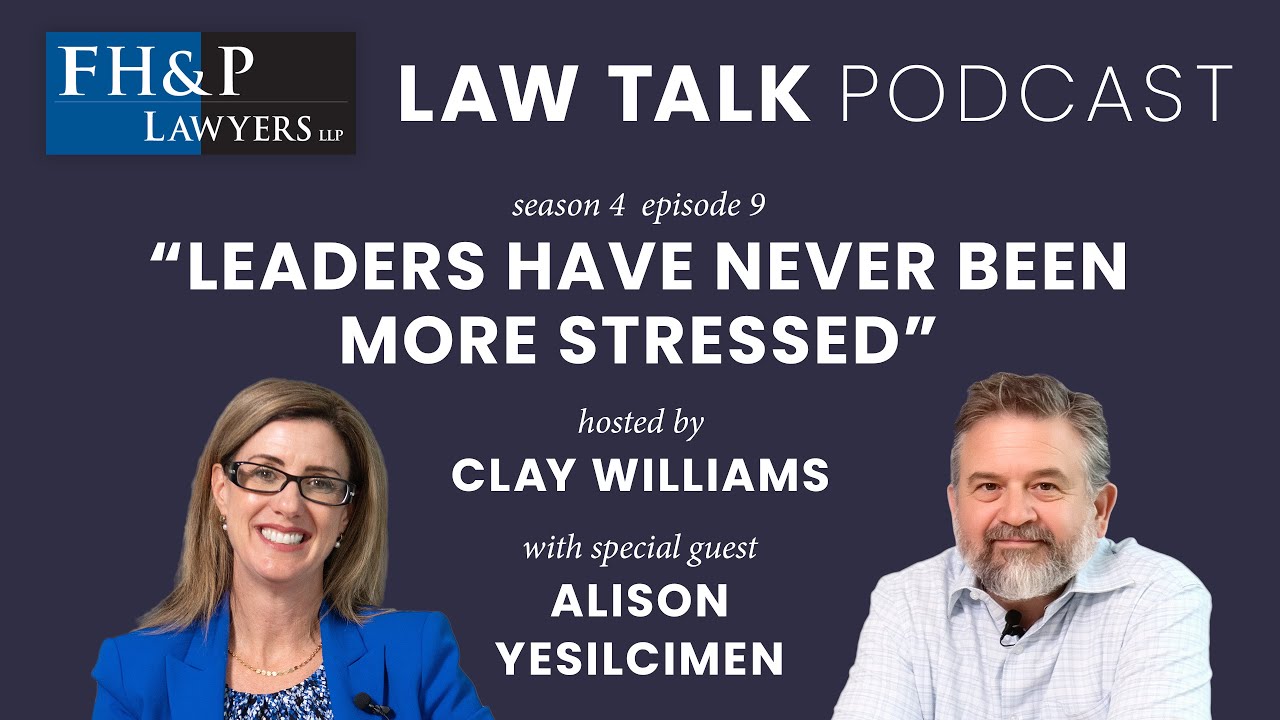
What is mental fitness—and why should every leader be paying attention? In this episode of FH&P Lawyers’ Law Talk Podcast, host Clay Williams chats with leadership coach Alison Yesilcimen about the real cost of burnout, the power of mental resilience, and why traditional “push through it” mindsets no longer cut it.
From Positive Intelligence to quick, science-backed techniques you can use in high-pressure moments, Alison shares tools that help leaders show up with more clarity, calm, and curiosity—at work and at home.
Clay: Welcome to another edition of FH&P Lawyers Law Talk. I'm Clay Williams. I'm a partner here at FH&P Lawyers. Really, really excited to have another guest speaker with us today, Alison Yesilcimen.
So, Alison, you are part of our speaker series, and what I wanted to talk to our listeners about today is that Alison is going to be doing a presentation at FH&P Lawyers as part of our speaker series. A lot of you have probably already seen some of our speakers in our series.
So, for those of you who haven't seen our series, you can sign up on our website and come on out. It's a live event. We try to do a series that is going to be interesting to people, to business people.
Clay: So, you are the head of Leadership and Development at The Now of Work, which is Rocky's company. Is that right?
Alison: That's correct, yes.
Clay: You've got a pretty interesting background. We were chatting before we started here. You've done a lot of stuff; tell us about it.
Alison: I moved up to Kelowna in 2001. I was promoted to run a newspaper company called the Okanagan Valley Newspaper Group, and so I packed my family up, moved to Kelowna, and did that for just about a decade. Then I got into the tech sector because I could kind of see where publishing was going at that point.
I've led a few tech companies, health tech, and a few others. I've also run a manufacturing company here in town. I've had everything from launching my own startup to scaling $80 million operations and leading a group of five people through to a staff of 200.
And now I'm on the show talking about the importance of mental fitness and why leaders are feeling so stressed and overwhelmed right now. It's tough out there.
Clay: Why don't you just tell us a little bit about what you're going to be talking about, build some excitement here.
Why Mental Fitness Is the Missing Link in Leadership
Alison: Okay. I've worked with a lot of leaders over the past probably two years, specifically. About 18 months ago, I had a transformational situation happen where a client asked me to coach their group through a program called Positive Intelligence.
I had never heard of it, Clay. I was kind of skeptical at the time, but I thought, be open, Alison. So I jumped in and I took this Positive Intelligence program and guided my client through it.
I have to tell you, it changed everything I knew about leadership and how I was functioning as a leader. You and I have probably taken a lot of courses. We've watched a lot of podcasts. We've read a lot of books. But I had no idea how powerful our minds are and how detrimental they can be to our performance, to our relationships, and especially to our own health and well-being.
What Happens When We Ignore the Mental Side of Performance
Working with high-performance leaders, I see it all the time. We have been trained to just push harder, work through it, find a better way forward as opposed to stopping and taking a look at what it is that we're actually doing to ourselves and finding a better way to manage through that stress, that pressure.
It's constant. Let's face it. Since the pandemic, we've had cybersecurity attacks, and we've had AI disruption. It's been this constant flow of micro moments of stress that have been building. Leaders are really struggling through that.
Clay: You hear about it. It seems to be in the news. We hear about AI, but also mental health and being at your top performance. Now, where does Scotch fit into all this? —Just my personal way of getting through.
Alison: Mine's Merlot.
Alison: She comes in when I feel like I don't have the skills to be able to—but that's an avoidance task. I know we'll talk about that a little later on.
What I think is really important for your audience to know is that mental fitness—let’s think about this. When did you learn about physical fitness?
Clay: Oh, remember at our age we had to do those physical tests...
Alison: ParticipACTION! That's right. So yeah, I was good at that. You were probably pretty good at that. And now, when did you hear about mental fitness?
Clay: Yeah, that's been a much more recent thing…
Alison: I just learned about it about 18 months ago. But let's face it—mental fitness is beneficial to boost morale and performance.
It reduces stress. It helps you collaborate more effectively with people. It helps you with your self-confidence, and ultimately, it really builds your emotional resilience when challenges arise. And let's face it—every day there are new challenges arising, and we're sitting in a place of uncertainty, which also heightens that anxious feeling.
Clay: Now, are you directing this at leaders or at all employees? Of course, I'm making fun of Generation Y when I say that, who don't seem to appear to have any resilience.
Alison: We are all struggling with something. But no, this is something we can all learn. A lot of my stories and my information come from the leaders I work with. A lot of them tend to be Gen X. We kind of grew up very stoic—push hard, work hard, suppress.
So really, what I want to do is help everybody walk away with understanding what mental fitness is, what you can do when you are in a place of sheer anxiety or stress or anger or frustration.
There are some scientifically proven ways you can shift your mind out of that very quickly and into a calmer, clearer, confident, curious mindset. It's incredibly powerful when you learn this technique.
Clay: And I would think it would make you a better employer, too. Just interacting with your employees and your clients. If you're very stressed and you show it, people snap and do things that...
Alison: We get very activated, very angry when we are under high stress. We get activated very quickly.
Alison: You brought up a very good point. This isn't just around the boardroom table. This is also impacted around the kitchen table—how you show up at home.
Clay: That's actually a very good point.
Alison: It's interesting. A lot of the high-performance leaders I work with, when we work together, they realize that sometimes what they show at home is very different than how they show up at work. And that disconnect can be very disruptive.
Clay: And so you are going to give us some pointers on how to... now, what is the word I'm looking for? When you think about what you're thinking, you're aware—what's that word?
Alison: Like mental awareness?
Clay: Yeah, yeah. Something like that. But is that what this is kind of about—being aware of where your thoughts are going and what your thoughts are, what you're telling yourself?
Alison: Absolutely.
Mental Fitness vs. Meditation: What's the Difference?
Clay: You know, here's something that my listeners might not know—I do meditate. Is that something you're going to talk about?
Alison: Meditation is absolutely critical to helping you focus on shifting into a calmer, quieter state. That is one, but that is not what I'll be focusing on that day. I'll be showing a few different techniques that you can use.
Again, when you're around the boardroom table, it's hard to sit and meditate. These are quick, easy ways to shift your mind when you start to feel...
Clay: When you're in it?
Alison: Yeah, when you're in it. And it's pretty hard to meditate when you're talking to a client and you're getting frustrated, or you're looking at your partner and you're starting to get judgmental.
Clay: So, I'll tell you, you gave me a couple of things that you wanted to talk about, but since it's my podcast, I didn't even look at them. So let me look at my speaking notes here.
Some of the things you wanted to talk about were how our greatest strengths in sabotage rest and fuel burnout. I think you've talked about that a bit.
And how small daily mental fitness practices build resilience in real time.
See, to me, I think that's meditation. It's a daily thing that you do, and it seems to build. But you've got some other ideas.
Micro-Practices That Build Resilience
Alison: It's habit stacking. Really, what you're talking about is habit stacking—every day, utilizing your mind in a way that's to your advantage as opposed to your disadvantage. Making it your best friend versus your biggest obstacle.
And the one thing that I really want to impart to your audience is how it is showing up for you is going to be different than how I talk to myself and how I sabotage myself.
Because my superpowers could be very different than yours. And when they're taken to an extreme or overused, that's when they become detrimental. And people don't really realize that until they realize it.
Clay: Do you want to share any tips from your presentation, or are you going to leave that...?
Alison: I'm going to leave it there and say, Come to the event. It's going to be so much fun. It's very interactive, and we're going to learn a few things and walk away with some really great skills.
Clay: Well, and you have defined it here as leaders, but it's not just employers.
Alison: Yeah. You know what—you could be leading a Girl Guide group, a sports team, or your household. Leadership is a very broad term. We are all leading in some way.
Everyone Is a Leader—Here’s Why This Applies to You
Clay: It is, isn't it? What is a leader? I guess in our age group, a lot of us are employers, leading business groups and such, so I would think that would be very interesting to them.
You're right, there's a lot going on right now. A lot of employment pressures and regulations, and better integrate AI into this or that. A lot is going on, for sure.
Alison: And again, you're talking about leaders who have grown up pushing themselves—often through negative chatter in their mind.
"Come on, you can do this. Hurry up. Push harder."
They push, push, push, as opposed to sitting back and saying, "Okay, what would make this a bit more of a pull than a push? What can I do to maybe lean in and get a little bit more curious, as opposed to being a little bit commanding or controlling?"
And again, I think that's where I see a lot of high-performance leaders not realize the detriments. They think they're getting higher performance when in fact they're not.
They think that they're helping with their relationships—with their siblings, their children, or their partners—and they're not. It's the lies we tell ourselves, but we don't really realize it until we take a moment to really look at how it is impacting us on a daily basis.
Clay: Are we going to be going through some exercises?
Alison: Absolutely.
Clay: Oh, that's very exciting. Okay, well, I'll be there because I think I'm pretty awesome. And I'd like to know if I'm telling myself a lie or not. So I guess we'll find out on September 16th.
I'm just really happy that we're doing that at FH&P and having a live... is it a show or presentation? I guess it's a presentation.
Alison: I like to call it an interactive presentation. But yes, it really is about helping educate the audience and providing a better way forward.
Clay: Yeah, I can't wait. Sign up on our website to attend our Speaker Series session on how ‘Leaders Have Never Been More Stressed: Why and What to do’. It's a free event, and like me, you'll probably learn something even if you think you're as awesome as I think I am.
I'm sure there's something there to learn about. I guess it reduces wrinkles, regrows hair...
Alison: You may cut back on your Scotch, but it may improve your golf game.
Clay: Yeah, I like that. Oh, I hate golf. I'm so bad at it.
Alison, thank you very much for coming out. I'm really excited for September 16th, and hopefully, a lot of our listeners are going to sign up. Come on out, see it live, and I know that we're going to get a lot out of it.
Clay: Until next time!
From managing pressure in the moment to shifting long-standing mindsets, building mental fitness isn’t just good for performance—it’s essential for sustainable leadership. At FH&P Lawyers, we’re committed to supporting business owners, executives, and teams with insight that goes beyond legal strategy—because how you lead matters.
If you’re looking to strengthen your leadership approach, protect your people, and navigate today’s challenges with more clarity and resilience, reach out to our team to learn how we can help.