Civil Litigation & Personal Disputes, Family / Matrimonial Law, Radio/Media
Canada's New Tort Of Intimate Partner Violence: What It Means For You
June 26, 2026 by Clay Williams, David Horvath
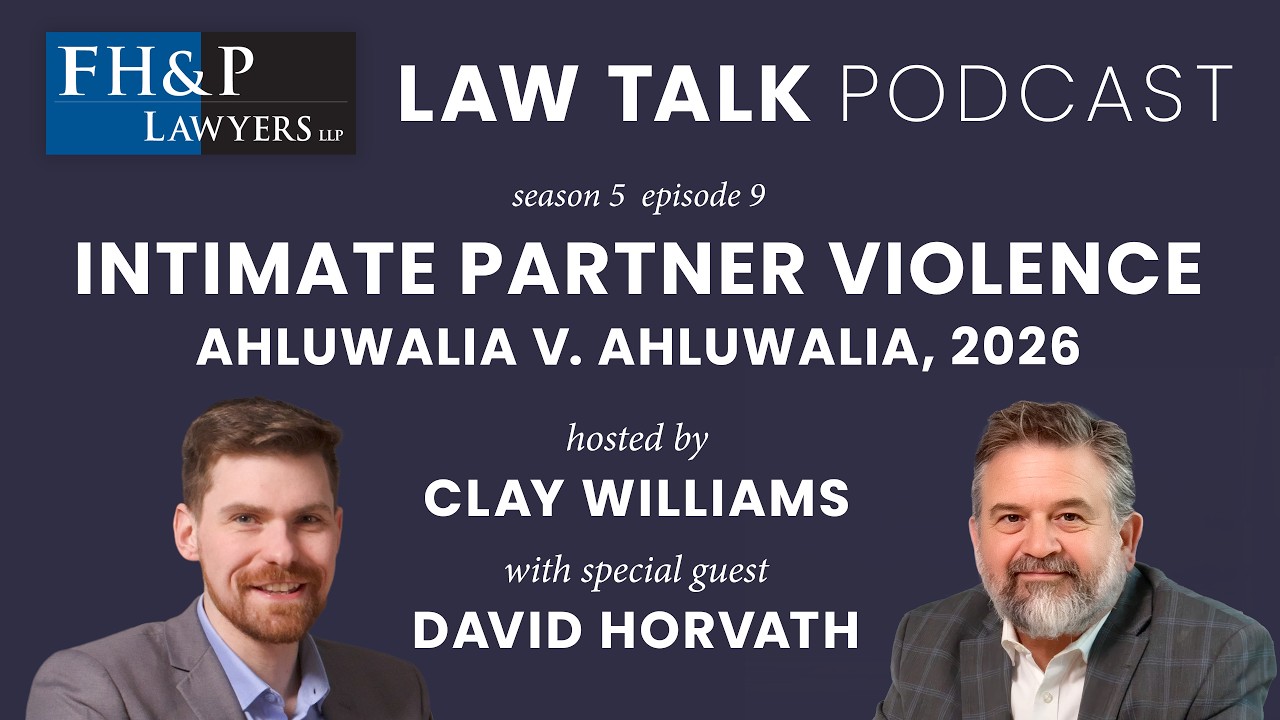
The Supreme Court of Canada has recognized a brand new civil cause of action: the tort of intimate partner violence. This decision is being called a landmark ruling, and for good reason. It creates a legal pathway that did not previously exist for people who have experienced coercive, controlling conduct within an intimate relationship.
In this episode of Law Talk, Clay Williams speaks with David Horvath about what the decision says, who it applies to, what damages are available, and what concerns it raises for lawyers and their clients.
What Is The New Tort Of Intimate Partner Violence?
The case involved a married couple with a 16-year relationship. The husband engaged in what the court called coercive behaviour, including sexual, financial, psychological, and verbal abuse. After 11 days of trial, the lower court found that this conduct constituted a tort.
The Court of Appeal disagreed. The case then went to the Supreme Court of Canada, where five of eight justices ruled that the tort of intimate partner violence should be recognized.
A tort is a civil wrong, a cause of action. You cannot simply say you are angry at someone and take them to court. The facts have to fit within a recognized legal framework. This decision creates a new one.
What Is The Legal Test For This Tort?
The court distilled the test to three stages.
First, the abusive conduct must have arisen within an intimate partnership, or in its aftermath. The court specifically included what happens after the relationship ends, which is a notable point.
Second, the conduct must have been intentional. This does not mean the person said to themselves, "I am going to coerce this person." It means the conduct itself signals intention. For example, one person controls all the finances throughout the relationship and gives the other a limited stipend as a form of control. The court says it can infer intention from that act, because what else could the person have meant to do?
Third, the conduct must meet the threshold of coercive, controlling behaviour that undermines the other person's autonomy in insidious ways.
What Does Intimate Partner Violence Actually Mean Under This Ruling?
The court is clear that intimate partner violence is not simply a dysfunctional relationship or an unhappy marriage. It is something more.
The court said the person alleging the tort is no longer able to be themselves. They are not in control of themselves. The other party is. The court quoted this framing from the decision: the intimate partner is not simply seeking compensation for the physical and psychological bruises recognized by existing torts. In effect, they are alleging, "I am not just a bruised spouse. I am an unfree spouse."
Conduct that may meet this standard includes sexual assault, financial manipulation, and psychological manipulation. A particular feature of intimate partner violence is isolation, which the court noted appears in other contexts as well, including elder abuse.
What Damages Are Available?
The plaintiff in this case was awarded $150,000 at the trial level, broken into three categories:
General damages (pain and suffering): $50,000
Aggravated damages: $50,000
Punitive damages: $50,000
The Court of Appeal removed the punitive damages, leaving $100,000. The parties agreed before the Supreme Court of Canada not to challenge that award, so the Supreme Court did not rule on what the damages should be.
What the court did say is that the extent of damages will be tied to the nature of the conduct. More serious conduct should attract higher damages. This case is not a firm guide to future awards. That will be established by trial decisions as the case law develops.
One important note: the court said the coercive nature of the conduct is not an aggravating factor on top of the tort. It is the tort itself. That has implications for how damages are argued going forward.
Can A Person Claim All Types Of Damages?
Not necessarily, and the interaction with family law is where this gets complicated.
This tort arises most commonly in a family law context. In addition to a tort claim, a separating spouse may also be seeking spousal support, property division, and other relief under the Family Law Act or the Divorce Act.
The concern is double recovery. If a person receives $200,000 for the tort of intimate partner violence and also receives spousal support, how do those awards interact? The Supreme Court of Canada left that issue to the trial judge. The expectation is that the tort award may be reduced to some extent to account for support already received, but that will be determined on a case-by-case basis.
It is generally advisable to bring the tort claim and the family law claim together, because enforcement and recovery of a civil judgment can be difficult when there are no family law assets to work with.
Loss of income claims may also be available if coercive control prevented a person from working. The decision does not rule on this directly, but it leaves the question open.
Will This Tort Open The Floodgates Of Litigation?
This is a genuine concern, and it was central to the debate within the Supreme Court itself.
Three of the eight justices dissented. They argued that existing torts, including assault and battery and intentional infliction of emotional distress, were already sufficient. Their position was that a new tort was unnecessary.
The majority of the five disagreed. They said there is a gap between those existing causes of action. When someone sues for assault and battery, they are pointing to a specific act on a specific day. Intentional infliction of emotional distress works the same way. What the tort of intimate partner violence captures is something different: a course of conduct over time. Many acts, done across months or years, that collectively constitute abuse. That course of conduct was not fully captured by what came before.
The court's view is that people deserve a mechanism to bring that full picture before a court and receive some form of recognition and compensation for it.
As for whether this will lead to more litigation, the honest answer is: probably yes, to some degree. Family law disputes are emotionally driven, and lawyers are trained to include every available claim when the facts support it. But the requirement to demonstrate coercive control over time is a meaningful threshold. This is not a simple claim to bring.
Does This Tort Apply Beyond Intimate Partners?
Not yet, but the court left the door open.
The decision specifically states that this ruling does not bar future courts from recognizing similar torts involving other family relationships, such as a parent and child. The same course of wrongful conduct, the isolation, the control, the psychological manipulation, appears in contexts like elder abuse. Those situations have been difficult to address through existing law.
The court acknowledged that gap, but could not address it in this case. The facts before them involved a 16-year marriage, and the ruling had to stay within those facts.
Whether future cases will develop a similar cause of action in other family relationships remains to be seen.
Do You Have Questions About Intimate Partner Violence And Your Legal Options?
If you are dealing with a situation involving coercive control, financial manipulation, or other forms of abuse within an intimate relationship, the general litigation team at FH&P Lawyers can help you understand what options may be available.
Contact FH&P Lawyers to speak with a member of our team.
FH&P Lawyers is a mid-sized Okanagan law firm with offices in Kelowna and Penticton.
Disclaimer: This material is provided for informational purposes only and should not be construed as legal advice on any subject matter. Consult with a qualified lawyer for advice on specific legal issues.