Radio/Media
FH&P Lawyers Talk Freestyle BC’s Okanagan Shred Sessions: Kid and Youth Programs, Clubs, and Future Pathways
February 19, 2026 by Brett McClelland, Clay Williams
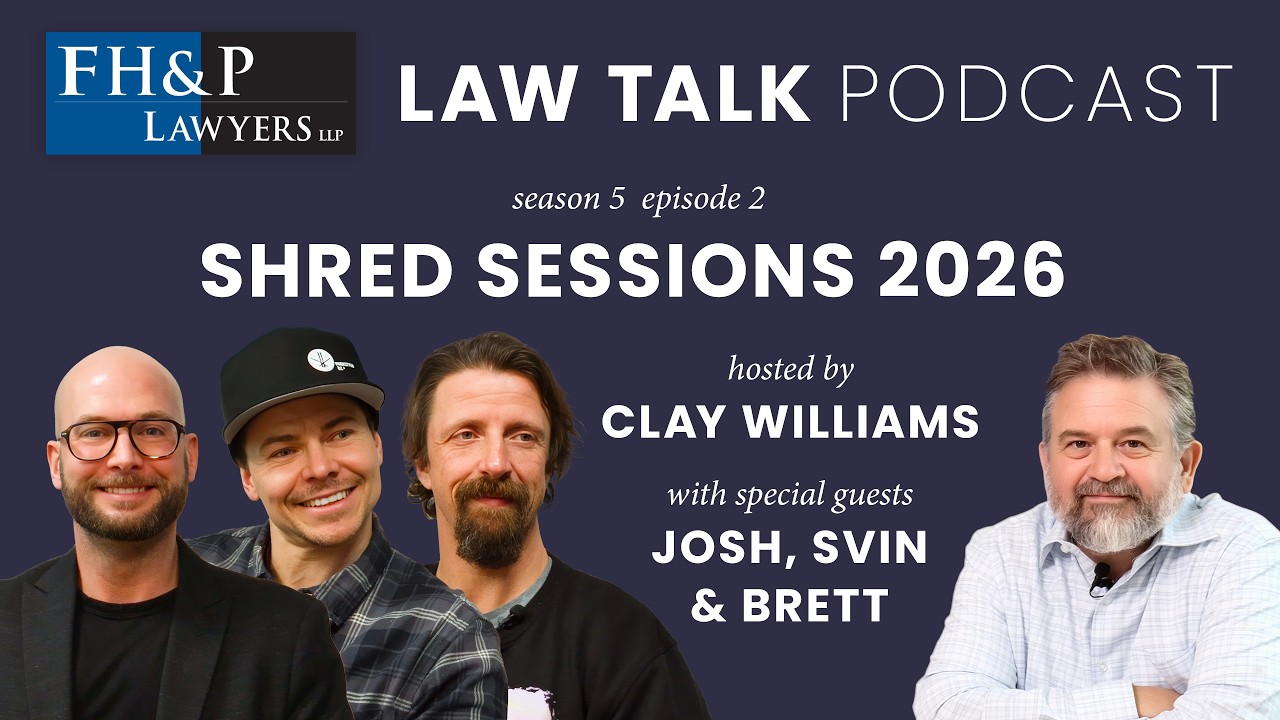
Freestyle skiing looks amazing on TV, with tons of disciplines like moguls, slopestyle, halfpipe, and big air. It can also be confusing if you are trying to figure out where your kid fits, how judging works, or how to get started. On this episode of Law Talk, FH&P Lawyers’ Clay Williams sits down with the Freestyle BC team and Associate Brett McClelland to break down the main disciplines, explain how events are scored, and share how local Shred Sessions are making it easier for Okanagan families to get involved closer to home.
Clay: Hey, it's Clay Williams, and welcome again to another edition of FH&P’s Law Talk. I'm a partner here at FH&P Lawyers, and we are recording this the day before the Olympics start. So we've got a cool show that you're going to like today because we've got the guys from Freestyle BC here today. Now you guys were here before, hosting our very first Freestyle BC: Shred Sessions feature. Svin & Brett, you came and took over my show, and it was great. Josh, it’s nice to have you here this time. So let's start by just introducing yourself and telling me what you do with Freestyle BC.
Josh: I am fortunate enough to work with these guys, and my role is executive director for Freestyle BC. I've been in this chair for eight years, leading the organization and serving an amazing community of athletes, coaches and officials, working very closely with an incredible board of directors. Most of them are alumni of the sport, so they know it well. Yeah, we get to deliver great programs for awesome kids, keeping them outside, doing fun things.
Clay: Excellent. Svin, tell us, what's your role at Freestyle BC?
Svin: My name's Svin, I’m an events manager for Freestyle BC, so kind of the overseer and coordinator of all the club and regional events, from regional up into provincial and a little bit of national level events. Anything that's kind of within the province of British Columbia. Officials, judge development, that sort of thing. Just making sure all the events go smoothly. Everyone's safe, fun and fair, and it's a good way to stay involved in the sport!
Clay: All right. We've also got Brett. Brett is an associate lawyer here at FH&P Lawyers. The reason that you're here today, so, Brett, why don't you introduce yourself?
Brett: Yeah, I guess I'm the bridge between the two worlds here. I'm also the vice president of BC Freestyle Ski Club. This is an original series that we kind of came up with a few years ago, and just really wanted to bring it closer to home. So it's easier for kids to get into the sport and make it easier for volunteers to get experience, so that we can really keep this volunteer-driven sport alive and thriving.
Clay: Now, I listened to your podcast, so a couple of things that I think we need some explanation on. First of all, what is freestyle? When you guys were talking last time, you were using these terms—we're going to do slopestyle, we're going to do more. Well, what is all this stuff? What are these disciplines?
Breaking Down the Main Freestyle Skiing Disciplines
Josh: Let's each tackle one of them. I used to be a mogul skier back in the day, in the late 90s, early 2000s. I had dreams of being like Jean-Luc Brassard. You go through a field that these moguls that are practically the size of a Volkswagen, and you're going through these giant bumps, 2 or 3 or sometimes four per second, and you've got two jumps, and you've got to do your big tricks off the jumps, land back in the mogul field.
So you're judged on your style, the degree of difficulty of the tricks, and how clean you can ski down the mogul line. Then the time is a factor as well.
Clay: So, how do they judge these things on style, on flips, or how does that work?
Josh: Well, we've got to talk to the judges about that one. I mean, I can give you a fairly close range of what they're looking for. Some of it is on turns. Yeah, some of it is on air, and some of it is on speed.
So you would have a base score for turns, and for every mistake or deviation, the judges will make deductions from that. Your jump, the judges will have a score book that says you did a backflip or a backflip with a grab or this or that. So then there's a degree of difficulty that they'll multiply that by, and again they'll say, here's your raw score for how clean you did that and how well you landed it, and then multiply it by the degree of difficulty.
Then the speed is based upon a pace set, either delivered by a forerunner or measured by how long the course is and how steep it is. They predict what the average time should be, and then you get a score based on how close you are to that time. If you beat it, then you get a really good score, and if you're behind it, obviously, your score will atrophy.
Clay: So this year we're going to see in the Olympics two racing side by side. That's going to be exciting.
Josh: That's super exciting. In single moguls, it typically goes to the very best skier. We know that Canada actually has the greatest mogul skier of all time. So Mikhail Kingsbury will be the guy to beat.
He loves being in that spot. Yeah. He's also a very good dual mogul skier. That's anybody's game because it's like head-to-head, and that adrenaline of pacing the other guy down the course. We have a lot of great skiers representing Canada at the games who are from B.C., but maybe we'll touch on that in a bit. I want to hear more about the other disciplines.
Clay: So what are the other disciplines?
Svin: The next one is probably slopestyle. That was kind of born out of the more, let's say, rigid mogul skiing. Right. So, free ski, if you will, was born. So this is a combination of kind of jumps or rail features, sliding features, peak rate through the course on the way down. No timing involved. It's just judging if they can put down the smoothest, most kind of creative run that they’re capable of.
Clay: So this is what I see on TV. There's a bunch of structures and rails and all that kind of stuff.
Svin: Yeah, they're getting pretty creative with what they’re putting out there. The different types of rails, up rails, down rails, rails ups with a flat section, that sort of thing. As the sport kind of evolves and the coaching gets better and the facilities and training get better, the stuff that we're seeing nowadays is like, there doesn't seem to be a ceiling. It just keeps getting better and better.
Clay: So are there any more?
Brett: Yeah, there are more specific ones. There’s still big air and my personal favourite, which is the half-pipe. It's essentially what it sounds like, half a pipe built into the snow. Basically goes down. It usually takes about 45 seconds per run, probably 4 to 5 hits, sometimes six, depending on how big you go. You're looking to do the biggest trick you can, as high as you can, while still being stylish and making it all look very smooth.
Then, with big air, as the name kind of entails, you hit a massive jump, you’re either going backwards, which we call switch, or you're going forwards, and you are trying to do as many spins, flips, and tricks that you possibly can before you get back down.
Who Can Join the Freestyle BC Ski Clubs & Next Steps
Clay: It just seems to get crazier every time I see it, especially with big air! So with Freestyle BC, who are your members? Are there children? Is it anybody? Who joins Freestyle BC?
Josh: I would say a solid 65 to 70% of our membership would be youth aged 6 to 12. Then the rest of them would be 12 to roughly 17; they’d be the core audience for our athletes. We're always looking for different ways to retain athletes longer. A part of the Shred Sessions in the shred series is creating more regional opportunities to allow more families to be engaged closer to home, giving more opportunities to kids in the community, to get into it and stick with it.
Clay: Then it sounds like a youth program mainly. Is that fair?
Josh: I think so, yeah. I just don't want to close the door on opportunities for other people to get involved. While we don't necessarily have like master's programs, it is something that we're looking at very carefully because a lot of kids—
Clay: —I laugh. I'm just thinking of people my age and now doing flips. Forget it. I think I would break!
Josh: I mean, perhaps, but if you're given the right direction and that's what our programming is all about. If you wanted to learn a flip, you're not too old. But we teach you how to do it properly by trained professionals in a trampoline environment. Then we would take you to — in the Okanagan — just south of Penticton to the Oliver Water ramps.
So, we would teach you how to do that while falling into the water. So, there's no consequence other than maybe a belly flop. Like that'd be a worst-case scenario. But you would be in a life jacket, so you’d be good.
Clay: It's not just adventure/ winter stuff anymore. You're doing this for your training!
Josh: Yes. You mentioned that there is a high degree of difficulty, and it is a sport based on risk. So it's about risk management. We move from trampoline to water ramp, and then we take you north up to Silver Star, and you'd utilize their airbags. So that's the next progression to simulating on snow. So now you've had 100 backflips on the trampoline until you've proven to your coach, and then you're going to do 100 jumps into the pond.
Then you're going to do 100 onto the airbag. At that point, you've got 300 plus under your belt. You're ready to go on the snow. It is something that even an old dog can learn, new tricks.
Clay:—Maybe not as old as me!
Josh:—but to your question, our primary audience is youth. Absolutely. That is our target.
How To Enroll in Freestyle BC’s Ski Club
Clay: So, for our listeners, if there are parents out there thinking, hey, that's pretty cool, how do you get into this freestyle? Is it a club you join, or how do you get involved? How do you put your kid in it?
Svin: I put my kid in it this year. Yeah, it's phenomenal actually, the first time I've ever had to stand at the top of the course as a coach, an official and a dad at the same time. It was something new for me. But yeah, we're lucky out in the Okanagan, and that's kind of why we have so much success, and why the Okanagan Shred Sessions can work: we have so many great clubs dotted around the province, relatively close to each other.
So join a club! There are many out there. The coaches can help assess where the kid fits within kind of the skill levels, generally at the fundamentals mark, to start things out, and through there, there are different kinds of progressions. Based on the skills they learn and where they want to go, if they're more of a moguls kid or a park kid or a slopestyle kid, they can start dabbling in different programs, and we try to help everyone get the skills needed to progress equally throughout the different disciplines. That's the best thing to do for overall athlete development.
But there are phenomenal programs and coaches across the province and certainly in the Okanagan, wherever you are. Get involved in a club, and then they can take you from there.
Clay: So, I guess that's the question. Each hill, it sounds like, has its own club.
Josh: You bet. So you would go to www.freestylebc.ski. That's who we are. So we're the Provincial Sport Organization (PSO), which oversees the government of each of the clubs. We have 17 clubs in BC. If you visit our website, there's a club finder. It explains our governance and best practices. So Svin oversees all of our events, including officials and judge development, as well as delivery of the Shred Sessions and our Timber Tour. Then we have another person tasked with overseeing all of our coach development to ensure they meet all the minimum requirements.
Then we give them an opportunity to continue their development and coaching. Then, from a club governance perspective, my job is to make sure they have a sound board of directors, a strong set of policies to ensure the coaches are treated well, and a secure, safe program for the athletes to be involved in.
Strong Governance, Stronger Athletes: Behind the Scenes of Freestyle BC
So, there are lots of opportunities in the Okanagan. As Svin alluded to, this has been a hot spot for talent for decades. We were talking about Milano Cortina. I can give you a broad shot. There are 11 athletes from BC who are going to be representing Canada at the Olympics. We have 12 coaches, some of them, you know, softwood lumber, people think is our best export. But I say it's our ski coaches! So we've got eight coaches that have come through our system that are now coaching for other nations at the Olympics in Milano Cortina, four of them for Team Canada. We have two guys running the Olympic broadcast, so they're going to be narrating moguls, slopestyle and all that stuff. Then we have the head TD overseeing all of the safety at the games.
At the Olympics is the same TD that we reference and train our officials here in BC. So we have a pretty rich history of developing all sorts of talent through our craft.
Clay: I’d say we’re pretty lucky here with the hills and the snow, I guess. So, there's a lot of skill, that is really good to know. We're so well represented.
Josh: So we're lucky to have the support of the resorts and having amazing mountains as we do. But it really comes down to a lot of the volunteers and the people who have been doing this longer than any of us. So the coaches, officials, BC's got a lot of depth from the 80s and 90s that we're just building on.
Clay: So I wanted to include Brett here in this. The reason that these guys are here is that Brett brought an idea to FH&P Lawyers, and so I guess I wanted to hear a little bit about the background. How do you move on from being a person who kind of does cool stuff on a mountain to getting to the Olympics? I understand that's events. Is that right? You want to talk about how that happens and then how you develop these Shred Sessions?
Brett: Yeah, I think it kind of ties into what you were asking earlier about how you get your team to the sport? When I first joined the club, the first thing I wanted to do was compete, go to other mountains, check it out, and see how I stacked up against the competition.
I had absolutely no idea what the pathway was until I joined the club. Then it was like, now we have people above me on the provincial team, and there's the national team. You really want to figure out how to get there. Generally speaking, you go through a competitive circuit, gain experience at a local level, build your confidence, then move to a regional level, start travelling more, and then go provincially. At that point, you probably get into figuring out whether you're going to go nationally and then internationally.
Balancing Competition With Skill-building & Community
Clay: Tell me about the system. Is it a point system? Is that what you're trying to get to, to advance and go up the rankings? Is that how it works?
Brett: There is a bit of a point system.
Clay: Well, how do I know or how does the Olympic Committee know we're going to pick this guy, not this person, etc.
Josh: Yeah, you're spot on. We have, at the shred level, we do judge, and they do get a score, but we don't want too much emphasis on outcome. It's really about the process, community and as Brett said, giving the athletes an opportunity to test their skills or perform on demand. Once you get to the Timber Tour level, that is very closely ranked. So we have a team of people who run all of our scores into a system, and we rank them. Then from there, you earn spots onto junior Nationals or Canada Cup level. Then, when you really have earned your keep, you can go further. At that point, maybe you've earned enough points to make it to the national program.
So ranking is important. But I think that's why Brett was being gentle around that, because at this level of Shred Sessions, it's about community. It's about bringing kids together. It's about developing so much more than just gold, silver, and bronze.
Clay: So this is the second year for these Shred Sessions, I guess. Is that right? So as I understand it, this is kind of a local event to let kids see how they like to compete for how they stack up against other kids. Is that fair?
Brett: Exactly, is anybody from Sun Peaks down to Baldy, any of the clubs in that area? They can come join and try their hand. You can get their other local competitors. So we got the Mt. Baldy club, there's the Apex Freestyle Ski Club, the Big White Freestyle Ski Club, Silver Surfers, those people. Then I have some peaks.
So anybody in that region can come out, try them out, and get some experience. One of the best parts that we found is that it's building up the volunteer pool, and the parents are getting to know each other, so that when their kids are going to that next level, they know if they can make a trip, it's easier for them to send their kid with somebody else.
The clubs are building relationships with each other, and we're getting more trained officials to come take the burden off some of the older judges, the older kids, the older chief of comps, and we're just building up that talent pool, so that we can keep going up to the Olympics.
Growth of the Okanagan Shred Sessions
Clay: How's it going this year?
Brett: It's going really well. I think at Silver Star, one of my favourite moments was a guy who was just on the panel for the free ride judging last year. He was the head judge this year, and he just absolutely knocked it out of the park. He took the other new judges that he had this year right under his wing, and was explaining everything. I walked into the comp office that morning, and I was just unbelievably thrilled with how well he had stepped up into that role.
He didn't let anything fluster him. As with every freestyle skiing event, there are always weather challenges, and he had absolutely no qualms with adapting on the fly. It was great, and well, that's great.
Clay: So this is, I think you explained it to me, this is kind of an event where kids can go without as much competition, it's not so much about ranking, it's just to see how our competition works. Is that fair?
Brett: Yeah, we do hand out medals. We do have the Stoke cup.
Josh: Absolutely, there are results there. It's just not a heavy emphasis on it. It's not points or rankings to get you to a certain level. It's just, it's like you wouldn't earn a spot on the provincial team at this series.
Svin: Yeah, it’s an opportunity to experience this sort of skill-building.
Clay: But you don't have to drive the Whistler either, I guess.
Reducing Barriers for Youth Athletes
Josh: I mean, that's the root of it. We wanted to reduce the financial barrier, create more opportunities. I look closely at other sports models around the world. Norway is one I look to carefully; it has a population of around 6 million people. They usually win the medal table at the Olympics. They win more than any other country, China, the US, you name them, they're the best nation in the world. It is against the law for a 12-year-old in any sport to travel more than 100km to their event.
Clay: Really, wow.
Josh: It's not just best practice. I don't think Canadians would love it if we started imposing laws like that. But the point is, we want to create more opportunities to reduce financial barriers and create more opportunities for volunteers and officials. Brett, you nailed it. Like the fact that we trained somebody up last year, or rather, when you gentlemen trained up new officials last year and that they were able to take the lead, that tells me that these people want it. They just need the opportunity.
A good example that I lean into locally is the Whistler workers. It is an incredible population of volunteers who care a lot about alpine ski racing. They have a pathway, they have a long list of people waiting to get up to the grassroots because they know eventually that crew is going to the Olympics, they might volunteer for 20 years, but they're going to be there in Milano Cortina.
They're a globally recognized support group. So that's one of the models we look at for creating opportunities for people to do things that they would like to do, which is supporting youth in the community.
Clay: I never thought of that that way. I thought about it as a youth event, but it's creating more than the youth. It's creating coaching and judging as well. That's great. So that's good to hear.
So, thanks for bringing these guys here. As soon as Brett brought it to the partnership, as a partner, I thought, that's perfect. I'm a cool guy. I can hang out with a bunch of cool, freestyle colleagues wherever they are. Sounds great. So I'm really happy that we had the opportunity, and that we continue to have the opportunity.
Josh: I will say thank you from the bottom of my heart, on behalf of everybody within the freestyle ski community. The support that you're providing gives us the opportunity to train and develop more volunteers, more officials, and create more opportunities locally.
It's no secret that, at very best, government funding to subsidize our programs will stay status quo. It hasn’t increased in 20 years. So a dollar then is $0.50 now. So, it's really hard to make a go of it. We need to continue to make meaningful connections within the community. So that's what this is. Continue to diversify how we support our programs.
It is what it is. Skiing is a sport that takes a lot of resources to get to the mountain, to buy your skis, and to buy your boots. But we still make every effort to reduce as many financial barriers as possible, so that as many kids can get into it and stay in it. We could not do without you!
Clay: Thank you very much. That's great. Well, here's to a continued partnership! Guys, thanks for coming. That was a great session. We are so happy to be able to sponsor the Shred Sessions. Thanks for coming out and telling us how important our sponsorship is and what the heck freestyle skiing is, and what we're supporting. So, I hope that we can see you again.
For our viewers, if you want some more information, please go to www.freestylebc.ski. See you next time!
Freestyle skiing is not just about big tricks. It’s structured coaching, judging, and step-by-step progression that helps athletes build skills safely while keeping the sport community-driven.
If you are a parent looking for a local club, or you want to learn more about Shred Sessions and how to get involved, Freestyle BC has clear pathways and opportunities across the Okanagan and the rest of BC, so don’t miss out.
Disclaimer: This material is provided for informational purposes only and should not be construed as legal advice on any subject matter. Consult with a qualified lawyer for advice on specific legal issues.