Business Law, Creditor/Debtor Disputes and Collections, Radio/Media
How to Protect Your Business When Creditors Come Knocking
April 24, 2026 by Clay Williams, Shane Gardner
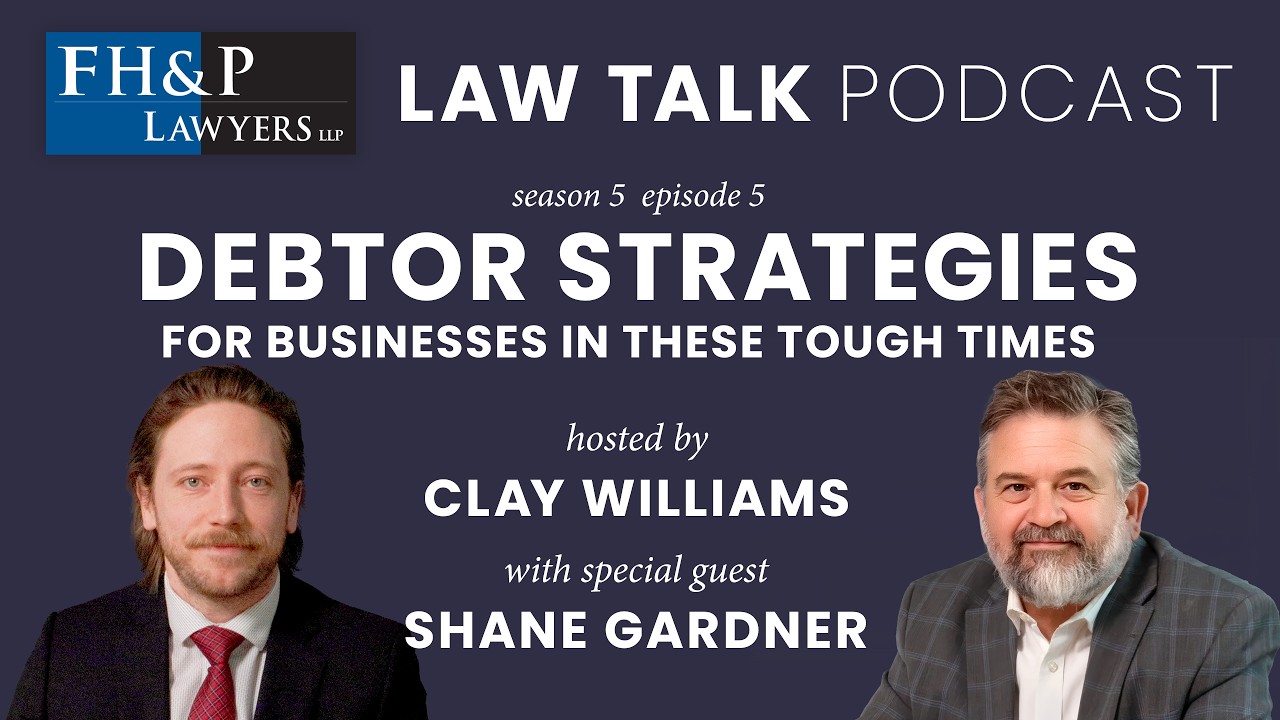
Welcome everybody to FH&P Lawyers Law Talk. I'm Clay Williams, your host, and I've got some great information for you today. I'm here with Shane Gardner.
In this episode, we focus on debtor strategies for businesses in tough times. We've talked on prior shows about debtor-creditor law and how things might happen, but today we wanted to focus on some strategies for your business when things aren't going well. You've missed some payments, you've got a demand letter, you might have been sued, or you've been contacted by creditors. We want to give you some strategies on how to deal with it. We're going to start with: don't sign anything without coming to talk to us.
Why shouldn't I sign anything before speaking with lawyers?
One of the things we see a lot is when people come in, and they've already done something. They've signed something. Just today, we had a client call in, and I think anyone can empathize right now that the economy is not in the greatest spot. So people are doing their best to try to keep things afloat. This gentleman was doing the same, trying to do what he could to keep food on the plate for his family.
Fair enough, FH&P Lawyers are expensive, and sometimes we are the walls, sometimes more gray than others. At the end of the day, he tried to resolve the problem himself. But he ended up signing some documentation in an effort to buy time and opportunity, and at the end of the day, ended up spending more of the time and opportunity that he actually had, trying to get something that wasn't really worth it.
When he came to us, we're going to do our best to help him. But had he come to us in the beginning, we would have been more able, had more of our own time and opportunity, to try and get him out of the hole that he's in right now.
This can't be addressed enough because we act for creditors, too. What we are always trying to do right off the bat is turn corporate debt into personal debt. We're trying to turn unsecured debt into secured debt. We're trying to add in other debtors, and trying to get guarantors and life partners in the door.
We see this all the time. People come in, and they've already signed something. They think, "I'm going to try and deal with this on my own," and they go and sign something. By the time they come to us, all of a sudden, they've turned a corporate debt into a personal debt. They've signed a mortgage on their house, or they've added their life partner. Don't do that, folks. There's a real thought out there that you're just going to throw good money after bad if you go and see a lawyer, but we can really take a look at it.
What should I do when creditors are knocking at the door?
When there are sort of the wolves knocking at the door, it's a frightening situation, and a lot of the time, you don't understand what the alternatives are. Let's say you have a lender. Your business, the lender, is calling the debt or calling a credit facility. You owe a substantial amount of money, and you think, "Look, I just don't have any other opportunities here. I've got to capitulate. I've got to sign." Maybe you do, maybe you don't.
A lot of that is going to be some business understanding. It's going to be looking at the agreements that you've entered into already. But some of that comes with us, and that's the practical realities of the situation you're in from a more legal perspective. For example, how much time you're going to be afforded through the reality of the court system, what type of proceedings are available to you, and whether you're going to be able to make a proposal. In the larger cases, if you're going to be able to avail yourself of a proceeding, there's certain instruments and levers that debtors, especially in the business context, can pull in order to buy themselves that time that they initially sign off for, without really having to sign off on that time and opportunity that they're spending.
There's nothing wrong with asking a creditor to show what they've got. We've seen many times when creditors come strong out of the gate, because we do that too, and make a demand on the company and a demand on the principal of the company. When we ask to see the credit agreement, it was signed years ago, and they can't find it. One of the first things we'd want to do would be to tell you what your liabilities are, find out what the liabilities are, and then proceed from there.
How do FH&P Lawyers help assess my situation?
You have to be realistic to a certain extent. Sometimes we work with trustees as well. We've got partners throughout the Okanagan, and it's really taking an honest inventory of what you have, what you've agreed to. From there, how can we strategize? How can we build a plan to get you where you need to be? It's a very sobering look at the way things are. The lenders for the most part, or the creditors, are going to be doing the same thing on our end. They're going to be doing some mathematical calculations. They're going to be looking at a legal team. What can they do? So we have to do the same thing. But there are opportunities. There are levers available that we can pull.
If you're in trouble, we'd like to see an exit plan. Sometimes the creditors are coming at you like an avalanche, and it's very scary and very hard. But perhaps there's another lender, there's somebody that can help, you just need a little time. That's where we can very often assist, or at least tell you how much time you've got.
What is a forbearance agreement, and should I sign one?
Forbearance agreements are something that the creditor often presents to you and says, "Look, you need some time. No problem. Sign this forbearance agreement." But that can really limit what we can do for you.
With the gentleman who called recently, that was a situation he had already entered into. It sounds great, right? We're going to give you a little bit more time. Of course, you're going to pay some more interest. But hidden in the smaller terms was, for example, you're going to turn this corporate limited debt into a personal debt. So he's giving up much more than he thought he would under the understanding that he's going to be able to crawl out of this. That goes to our initial point, which is, are you actually going to be able to? And what time do you actually have?
The realities of the situation are that you're going to agree to the amount of the debt, you're going to waive all your defenses, you're going to make big payments. In the agony of a business not being able to make its debts, you may think, "I'll sign this, and I get a little time." But we'd urge you not to. We'd urge you to come in and get an assessment on that.
Are forbearance agreements always a bad idea?
Sometimes it does make sense for both parties, and sometimes the forbearance agreement is the answer. If there is an honest chance of you crawling out, or if there is an honest chance of you recovering or making good on a defaulted credit facility, then fair enough. If any lender is willing to give you additional time, I've seen it work. But you want to be careful on both ends. Sometimes we're acting for the lenders as well. Just because it sounds good doesn't necessarily mean it is, and just because we're scaring you a little bit doesn't necessarily mean it's not a viable option. Ultimately, underscored, redlined, highlighted: you want to be careful. That's where we can help you.
We're not saying that a forbearance agreement is always bad. We're not saying that guaranteeing something is always bad. It's really important to know what it is you're signing before you do that, because sometimes that's something necessary in order to get that time, to get that new financing, to change whatever is affecting the business. It's really common for people to sign stuff in the throes of the situation, and it really affects things down the road.
What due diligence should a lender do before a forbearance agreement?
From the lender's perspective, sometimes that additional time you're giving out can be fairly detrimental. When you're entering into a forbearance agreement, you want to make sure you're doing a bit of due diligence as well. For example, if you're working with a business, it's always nice to be able to do a form of a credit check or look into whether there are any prime charges from the Government of Canada, and whether there's any outstanding payroll tax or anything like that. If you are secured, you want to make sure that you preserve that security position and move somewhat quickly. That's the nuances of all these different situations. They can work. They are great tools.
What happens once I come in to talk with FH&P Lawyers?
You come in, talk to somebody like Shane, and we're going to take a look and see what the whole situation is, what the legal rights are, and then make recommendations. Some of it is information that we're just going to have from going to court all the time. We're litigators. We have an idea as to what an honest turnaround time is for filing a court application, advancing a proceeding.
Sometimes you hear, "We're going to initiate a claim," and it feels like the world's crumbling. But we see this stuff all the time. We have a better sense of, okay, just because you filed a claim doesn't mean they're going to have a judgment right away. What does it mean when they do have a judgment? How long is it going to take? Within that, you can also build the strategy. If they say, "Enter into a forbearance agreement or else we're going to pursue a judgment," you might know that might be six months in and of itself, regardless if you enter into the forbearance agreement. So let's negotiate with a sense of perspective.
What's the difference between unsecured and secured debt when a creditor comes after you?
Being threatened with a lawsuit, being sued even, doesn't necessarily mean that a judgment is going to happen right away, unless you sign something. But when a lender or somebody with secured debt is coming after you, there are different considerations, but still things to look at.
You want to be careful, especially in some of the larger commercial context. If you've entered into a credit facility with a major bank, a lot of the time, they're going to have relief relative to pushing into an automatic receivership upon default. They're going to have rights and opportunities available to them to try and realize against their debt, which you want to be careful of.
When you're talking about receivership, a lot of the time that means you're losing the reins of your company, that the interest changes from the shareholders to the receiver, and the receiver is going to work for the creditors. Things can get wound up rather quickly. When you're dealing with the larger commercial context, and any lending in general, you want to look at the contract, have a FH&P Lawyer look through it, and give you that strategy about how we can get you out of here if we can, and if we can't, how can we get you out on the best outcome for yourself.
What if my situation is beyond repair?
We can't guarantee we're going to get you out. Things get to a certain state, and really, what we're looking for is to come to an agreement or give you enough time to get yourself out of it. At some points, there isn't anything we can do. Some of the things, like the Companies' Creditors Arrangement Act, are pretty exotic for probably a lot of our listeners. It's out there. At some point, there's always working with a bankruptcy trustee, too. We team up with them fairly often. They're the experts in the field and let you know what transactions are subject to what requirements, and how to best move through it. We could list a couple of people in the buildings next to us here who do a great job.
What's the first step if I'm feeling the pinch?
If you find yourself in a position where you've got the wolves at the door or the creditors breathing down your neck, the realities of the economy today are that you've got debts outstanding. You don't necessarily know what to do, but you're feeling the pinch. The first knee-jerk reaction is, "I don't want to incur any additional costs. I want to try and figure this out. I want to keep things tight."
Not that you want to ring the alarm bells on everyone, but it's very prudent to give a call to your counsel, whoever that may be, and have a sit-down with them or their team, whether they bring in a trustee or not. Really take a review of your situation, what debts you're looking at, what accounts you're looking to call on, and really try to exercise the time and opportunity that you have available. When you're looking at the time and opportunity that you might not have, that you're looking to purchase, make sure that you're purchasing it for a fair deal.
It's important to have a reason to purchase at that time too. We're not just going to sit there and try to delay things if there's an inevitable result at the end of the day. We want to know there's something there, but very often it's just a matter of getting some financing.
In the commercial context, there's a certain level of sophistication. Most people have a better business sense about what's going on out there. As long as you have a somewhat realistic conversation, you don't want to kick someone while they're down. Taking a look at their legal position, where they're at financially, and their overall business circumstance, and then trying to develop a plan from there, is your best bet.
What's your experience dealing with big commercial lenders like banks?
In the experience that I do have, it seems to be a bit of the luck of the draw. Some of the larger lenders across the nation are very quick to call their debt, and difficult to deal with. I think they have somewhat of a prerogative to make sure that that reputation is known, even if it means them taking a bigger hit than they otherwise could get from someone they're dealing with.
On the other hand, sometimes you're dealing with a local credit union, much more willing in my experience to work through it with you, much more looking to realize as much as they can in the long term and continue to build a relationship with whoever they're dealing with within the community.
Certain lenders are just so aggressive at times. They're almost acting against what they could get, when they could chill a bit and take a look at the whole thing holistically. Others are much more willing to try and work through it.
Unfortunately, it's a bit of the luck of the draw. It's tough to tell from a consumer or a customer's perspective who's taking out the loan as to what kind of treatment they're going to get on default. Or vice versa, from the lender's perspective, it's tough to determine what the prospect of someone repaying their debt is. The realities of the situation are what they are. The law is what it is. We can only help as much as we can, but there are going to be some variables in every situation. Making sure you've got the best pair of gloves on for the fight is a good idea.
When creditors are knocking, the instinct to handle it alone is understandable, but it often costs more time and exposure than it saves. Whether it's a demand letter, a forbearance agreement, or a claim already filed, knowing what you're signing and what time the law actually affords you makes all the difference.
If your business is facing creditor pressure, a demand letter, a forbearance agreement, or the possibility of receivership, getting advice early can help you understand what options are still open and what steps make the most sense for your situation. Reach out to us for a consultation, and we can help you out.
Disclaimer: This material is provided for informational purposes only and should not be construed as legal advice on any subject matter. Consult with a qualified lawyer for advice on specific legal issues.