Radio/Media
Medical Assistance in Dying (MAID) in Canada: A Legal and Human Perspective
November 21, 2025 by Clay Williams, Colin Flannigan
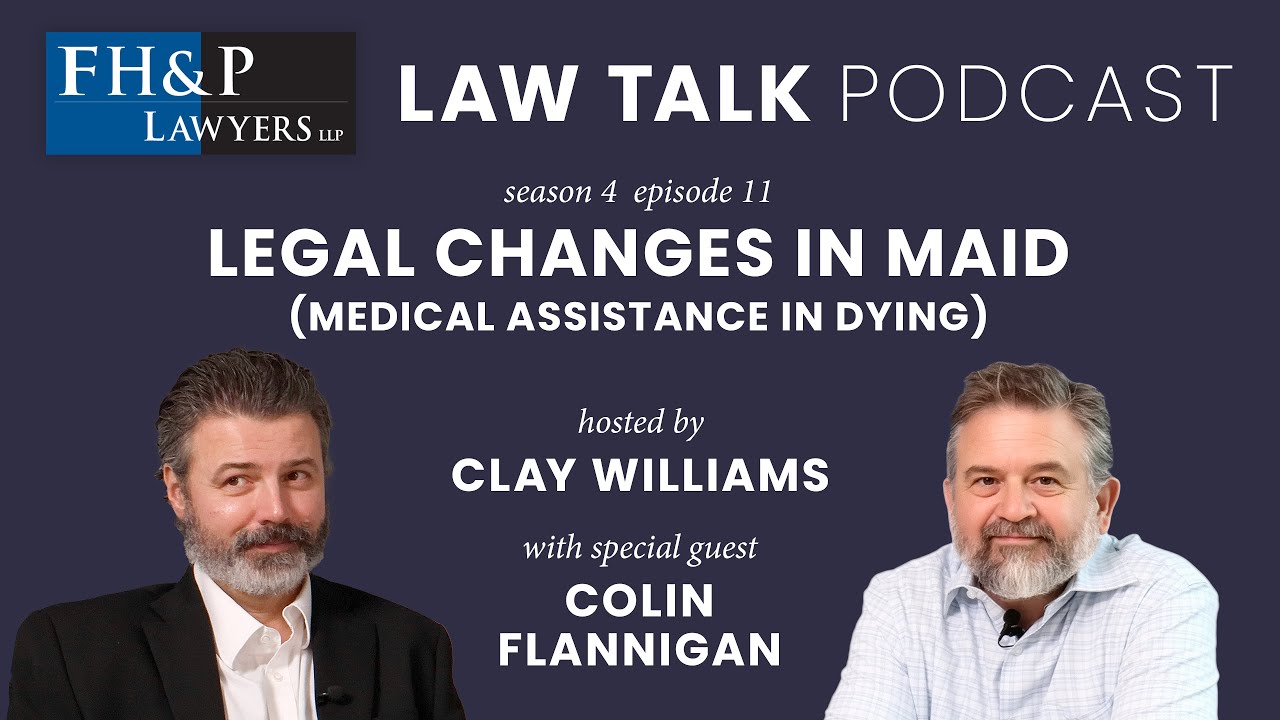
Medical assistance in dying (MAID) remains one of the most rapidly evolving—and deeply personal—areas of Canadian law. In this episode of FH&P Lawyers’ Law Talk Podcast, host Clay Williams sits down with lawyer and frequent MAID presenter Colin Flannigan to unpack where the law stands today and where it may be heading. From the original Carter decision to current debates around psychological illness, capacity, and advance consent, Colin offers clear insight into a legal landscape that is still shifting beneath our feet.
Clay: Welcome to another edition of Law Talk. I'm Clay Williams, a partner at FH&P Lawyers. And we've got a very interesting topic today. I'm here with our special guest, Colin Flannigan. Colin is here to talk about MAID (medical assistance in dying), and Colin, I have to say, you have won the contest for the most brief speaking notes. And I understand this because you've been speaking on this topic quite a bit. You're just off another talk that you just did. Is that right?
What Is MAID and Why Is It Evolving So Rapidly
Colin: Yeah. I just did a presentation for the Canadian Bar Association on the topic. So, for those of you who don't know, MAID is medical assistance in dying.
It's obviously an evolving area of the law, and it's something that is very personal as well. So because it's always evolving, I find that I do get asked a lot for doing either presentations or people having questions about what it is, what does the law actually say now? And one of the big hot topics is what's changing in the law because it is still such a juvenile or young area of the law.
It's in a constant state of flux. It's constantly changing, and it's currently changing now while we're talking. And it's going to be changing more as well. So it's one of those topics that people care about and want to know what's coming next because of how much it's already changed even in the last ten years.
Carter and the End of the Criminal Ban on Assisted Dying in Canada
Prior to 2014, before the Supreme Court of Canada decision, Carter, it was a criminal offence. It was a blanket prohibition on being able to assist someone else in taking their own life. It wasn't until the Carter decision. The trial decision was a couple of years earlier. But, with the Supreme Court of Canada, the decision said that it was unconstitutional to have a blanket prohibition.
That's when the law changed. There were changes made to the Criminal Code of Canada through Bill C-14. But it did take some time for that to change because the law was so entrenched for a long time, and trying to figure out how did the judges look at this as far as potential changes. That goes back to the original trial decision and looking at what procedural safeguards might be appropriate, because when we're talking about this significant a change in the law from blanket prohibition, not allowed at all, criminal offence, to allowing it, it needed to be set up in a structured way.
And the way it got structured was as an exemption under the Criminal Code. So even the changes to MAID that allow it are actually in the Criminal Code itself. And it's about trying to find a balance of what's the right fit for Canadian society, because each society has varying degrees of allowing this. It’s different because those societies are different in how they look at what they want to permit for this.
As an example, when it first became law in Canada, it was a bit more the restricted, to be quite frank with you. And there were other challenges that resulted. There are a couple of cases, the Shaw case, and there was the Audrey issue as well, where she ended up taking her life earlier than she intended to because of some of the safeguards that were in place from the outset.
Who Qualifies for MAID? Grievous and Irremediable Conditions Explained
So it is an area of the law that's already gone through a couple of major changes now. As a brief primer on it, basically, if someone is suffering from grievous and irremediable conditions—
Clay: —and you're talking about the procedure right now? I understand it's in flux. But this is the procedure right now—who qualifies, and what the procedure is?
Colin: Yeah. Exactly. So right now to qualify, you need to be diagnosed with a terminal or, well, some people think it is terminal, but the concept is going to be a grievous and irremediable condition. And that is one that's going to cause death. Now, there are two categories: whether death is reasonably foreseeable or not reasonably foreseeable.
It's slightly different processes or pathways in which people go. Right now, if someone is suffering from a condition and they want to qualify, usually they start talking with their family doctor, maybe even a social worker if they don't have a family doctor, because it does require two medical opinions that you are diagnosed with this condition that qualifies. When death is reasonably foreseeable, there's a set process as far as how you go about it. But when it's not reasonably foreseeable, there's a little bit more to it.
Chronic Pain, Suffering, and the Limits of MAID Eligibility
Clay: Can I ask you, just in hearing you talk—there must be an illness or a condition that is going to cause death. What about a condition where you're in pain all the time, 24/7? Where you think: I want this to end. Would that qualify right now?
Colin: You know, probably not. The reason I'm saying probably not is because the types of illnesses that qualify is one of those things that is changing, and the change that's going on right now and has been set to happen for a couple of years but keeps getting pushed off is it has always previously been a physical illness that's going to be causing death in this grievous and irremediable category, but it's the purely psychological illness.
Purely Psychological Illness and the Challenge of Defining ‘Irremediable’
This came from a joint parliamentary committee report that was done a number of years ago. There were a number of suggestions, but two main ones came out of this. And one was to open up MAID for people who have purely psychological illnesses. Now this has been planned. People have been working on this for a number of years now. There's still a lot of disagreement even within the world of psychology about some illnesses being terminal or permanent. Even if you look at concepts like suicidality, this is a very difficult concept because there are a lot of subjective opinions when it comes to when someone is going to potentially qualify.
So, as far as even within the world of psychologists, having people come to agree on what those standards are going to be for qualifying.
Diminishing Capacity and the Emerging Debate on Advance Consent
There is already one change coming up as far as what type of illness might be involved. One of the other illnesses that often gets brought up is ones with diminishing capacity. And that is something that's a little bit more complex, in all honesty, and that is the idea on advance consent. This was something I was touching on a little earlier about when death isn't reasonably foreseeable. Right now, you need to have the capacity to give a final consent before the procedure occurs.
Going back to that joint parliamentary committee report, the other major topic that came out was the idea of doing advance consent or waiving final consent. Now, that might only be possible when death is reasonably foreseeable, but not in the other pathway.
Quebec has taken further steps with Bill 11, in which they've already taken some of those concepts from that joint parliamentary committee report and looked at passing provincial law allowing for people, even when death isn't reasonably foreseeable, to try to provide that advance consent. So if they were to lose capacity later, like if you have a diminishing illness, this is a real concern for a lot of people.
Clay: So like an enduring power of attorney, if something happens to me down the road — or do you already have to be suffering from it?
Colin: You'd already need to be diagnosed with the illness, was the way that the Quebec legislation is geared, because that's where they went with the joint parliamentary committee report.
When it comes to the advance consent, Quebec has already tabled this provincial legislation, and as they've sought to get exemptions from the federal government or the RCMP about not prosecuting because it has not been changed in the Criminal Code yet. Right now, it doesn't look like that's going to be granted. So it has created a bit of a gray area, this push in Quebec to try to allow for this advance consent.
Recap: What ‘Grievous and Irremediable’ Means in Practice
Clay: Okay. So let's recap. There's a lot to unpack here. Right now, to qualify for MAID, you have to be diagnosed with an illness that is going to cause you to die.
Colin: The wording under the Criminal Code is ‘grievous and irremediable’. So when you're thinking about this terminal concept, that's usually captured under that grievous component. And that's having a grievous and irremediable condition. And currently, that’s only physical illnesses. It does not include purely psychological illness.
Clay: But you have to be going to die from it. Is that right? You are going to have to be diagnosed with something that you might die from?
Colin: Right now, the illness has to be grievous and irremediable. I'm not aware of there being any conditions that qualify as grievous and irremediable that are not terminal. When it comes to the terminal element, the question is whether death is reasonably foreseeable, as in it's terminal, you're going to deteriorate to the point where death is inevitable, or you're in the process of dying now. That's what you're trying to pin me down on. And that's where those two pathways come up: when death is reasonably foreseeable, and when it is not.
When death is reasonably foreseeable, and we know you're going to be dying within the next couple of months, maybe a six-month type of diagnosis, you might be looking at that first pathway, a simplified process where you qualify for MAID.
When death is not reasonably foreseeable, that's a slightly more complex process. It does require a second opinion by someone who specializes in that area, or if they don't, they have consulted with a specialist in that area.
Clay: So is that the path for a condition that is causing a whole lot of pain and ongoing suffering? Is that why somebody would qualify for that second path rather than death being imminent?
Colin: I wouldn't use that terminology because one of the big changes we've seen in MAID over the last couple of years—and we’re going to see more of this— is looking at less on the lawyers, and the law on this component and having more of a medical input.
Based on whether you're looking at it from a health authorities perspective, or even of the doctors within a certain field, their area, looking as far as what are the standards, as far as determining what qualifies as grievous, and irremediable. They've got the wording from the Criminal Code. It's going to be on medical standards.
Which Illnesses Qualify for MAID, and What Happens When Doctors Disagree?
Clay: Do you have some examples of illnesses that have qualified?
Colin: As far as ones I've seen, there are different forms of cancer, Parkinson's, and ALS. There are a number of different diseases that will qualify. When people ask if their illness will qualify as grievous and irremediable? It's going to come down to medical opinion, and it requires two opinions. Those opinions will need to be guided by criteria. But you do have differences of opinion, even among Doctors. And there has been this concept since about 2020 about people doing ‘doctor shopping’, where one doctor might find that your diagnosis isn't grievous and irremediable, and another might.
We've even seen issues arise where this comes into the courts, where someone may feel a person doesn't have capacity, and a loved one might say they shouldn't qualify because their family doctor doesn't think they qualify, but another doctor says they do. And the concept that one doctor might—is an alarming concept. But that is kind of the reality that there is with that situation. We've even seen issues arise where this does come into the courts, where someone maybe feel if they don't have capacity and it's a loved one, we're saying, I don't think this person should qualify because their their family doctor doesn't think they qualify, but yet they've gone out to this other doctor who now says they do qualify.
We've seen injunctions obtained by family members trying to prevent it, whether they're worried about undue influence, lack of capacity, or a condition that may qualify.
Capacity, Final Consent, and Why Substitute Decision-Making Is Not Allowed
Clay: Before we get too far, I want to ask, what about capacity? If a person gets diagnosed with a qualifying illness or condition and you're deteriorating, that's scary. Do I have to catch it before I lose capacity, or can I give the decision to somebody else?
Colin: Substitute decision-making is something completely different. When it comes to the changes we're seeing, Audrey Park’s case was going down this road. That's where we have the ability to maybe give advance consent in the first pathway, when death is reasonably foreseeable. The problem is in the second pathway, when death isn't reasonably foreseeable — you know you're going to pass from this illness, but it might be a year or two, but it's degenerative. At some point, are you going to lose capacity and lose your ability to consent to the procedure?
Going back to Bill 11, that was from that same joint parliamentary committee report. After the focus on purely psychological illness, there might be renewed focus on advance consent even when death isn't reasonably foreseeable.
Clay: So right now, if I've got a degenerating illness that is going to kill me, I'd better catch myself if I want to get MAID before I lose capacity, right? Because as soon as I lose capacity, I can't get MAID.
Colin: You're correct. If you're in the second pathway, where death isn't reasonably foreseeable, you need to have the ability to give final consent. If you're in the first pathway, you can give advance consent in some circumstances.
Clay: In terms of consent, is it a date I'm giving? I’m just trying to understand how it works.
Colin: In the advance consent, when death is reasonably foreseeable, you can request to waive final consent and say, ‘I'm not going to change my mind. I know I've got the right to change my mind, but I'm not going to. I'm worried that I might lose capacity.’ If you're in that first pathway, you might be able to qualify for that. But, if you're in the second pathway that isn't reasonably foreseeable, you hit the nail on the head about a lot of problems people are finding here. There's this gap, and that is, if you lose capacity, you lose your ability to have the procedure undertaken. So some people, the worry is, might be choosing to undergo the procedure before they would want to because they're worried about losing the ability to provide that final consent.
Substitute consent is not the law. We are not allowed to give substitute consent, whether through a representation agreement. When you look back to the original Carter trial decision, this was one of the topics looked at, and they chose that it wasn't something that made sense for that change.
Clay: And it may lead people to ask for MAID earlier than they might otherwise, because they're worried about that situation.
Colin: True. But there are a number of other problems that arise when you look at substitute consent, because who are the people you would name in your representation agreement? And for those that don't know, a representation agreement is for those who lose the ability to make health care decisions, including perhaps end-of-life decisions under Section 9 representation agreements, someone who can make that choice.
The types of people we’re naming in those documents are people we trust, right? Close family members usually. Those people are often the beneficiaries of our estate, whether they're beneficiaries under a will or life insurance policies, TFSAs, RRSPs, and those sorts of things.
With the Law, we've got the problem of what's known as Ex turpi causa, and one of the things we're even seeing with MAID as well, if someone doesn't have the physical ability to sign the request, someone else can sign on their behalf as a proxy is that's worded under the Criminal Code.
However, the people who cannot sign, even as a proxy, are those who will benefit under someone's estate. So that's a major issue. When you look at substitute consent, who would be the ones you would want to be able to make that decision? But then we have a problem about whether or not they should be allowed because they're going to be the ones benefiting, even profiting from your death. You don't want someone doing something for untoward reasons. Now, that's probably a gross minority, but it's still an issue that needs to be grappled with.
So, if we ever do look at substitute consent, it's going to be a very complex issue, and it's not going to be a quick change in the law. If that ever becomes a change in the law, it's going to be a very complex and nuanced process.
Psychological Illness, Politics, and the Future of MAID Reform
Clay: Let's go back to the changes happening right now with psychological issues. What's going on?
Colin: It's been passed in law, saying that it needs to be changed to allow for purely psychological illness, but the date by which it must happen has been pushed back multiple times. I was hoping last year it would come in earlier, around this Spring, but it got pushed back again. So there is still a lot of debate.
Clay: The psychological illnesses — is it for people who are suicidal or unhappy and cannot go through much treatment, would they turn the corner?
Colin: There are different complex issues, not just 1 or 2. I'm just pointing out a couple. But there are numerous others being grappled with in psychology, psychiatry, and other areas.
To point out how complex it can be, suicidality again. Someone wanting to take their own life is a psychological illness that can be grievous. But the big issue is irremediable. Is it permanent? What is perhaps another underlying condition related to that? Is it tied to bipolar disorder? What is the effect of medication? Is it truly irremediable? So it’s a very complex area with a lot of subjective elements in purely psychological illnesses. There is disagreement among medical professionals about what should qualify.
Clay: You said it's been pushed back. Was there a court decision saying the law must be changed, or is this just a discussion?
Colin: No, it has been set by law in bills passed in the House of Commons directing the Criminal Code to be changed to allow for purely psychological illness. But the implementation date has been pushed back a couple of times already.
Clay: So, you think it will happen at some point?
Colin: All indications are yes. It's already been set that the law needs to be changed. It seems it's just a matter of time until there is a consensus.
Clay: It's very political. Whoever implements it will have people happy and unhappy about it.
Colin: To be frank, since Carter in 2015, I've lost count of how many member bills have been brought forth recommending different changes to MAID. It can be very political because it's such a personal topic. When it's about someone's life, if people aren't happy with the law, they're vocal. Politicians listen to constituents. Changes can come from court cases, judges' decisions, or the legislature. There are many ways the law can change. And it has changed a lot because the law is constantly changing. Massive, seismic changes don't happen overnight. And in the case of medical assistance in dying, this has been a pretty seismic change in the last ten years.
Clay: You're right, from criminal to an actual procedure. We've only got so much time. Any other things you wanted to say?
Colin: If there are any other questions, I'm happy to answer them. It is a very complex topic. What I encourage people to do is if they've got any questions, take a look online, but talk to your professionals. If you've got questions about an illness, talk to your medical professional. If you've got questions about how this impacts things like your will or life insurance documents, especially outside Canada, talk to your professional. If you have a life insurance policy in Florida, talk to your Florida advisor to make sure you're not going to lose that policy if you go through this process in Canada.
Clay: We're lucky to have had Colin. Colin, I know that you regularly give talks on it. Watch our website; we do speaker series, and Colin appears on that on occasion. Thank you very much, Colin. And with that, until next time. Thank you!
Understanding MAID isn’t just about knowing the law—it’s about navigating one of the most personal and complex decisions a person or family may ever face. As legislation continues to shift, clarity around eligibility, consent, and capacity becomes essential. At FH&P Lawyers in Kelowna, our team is committed to offering informed, compassionate guidance rooted in up-to-date legal insight.
If you have questions about MAID, capacity planning, or how these issues intersect with wills or life insurance, reach out to our lawyers for tailored support. In matters this significant, trusted legal advice brings confidence—and peace of mind.
Disclaimer: This material is provided for informational purposes only and should not be construed as legal advice on any subject matter. Consult with a qualified lawyer for advice on specific legal issues.