Estate Planning, Radio/Media, Wills and Estates
Protecting Vulnerable People: Capacity, Exploitation and Legal Options in BC
November 28, 2025 by Clay Williams, Colin Flannigan
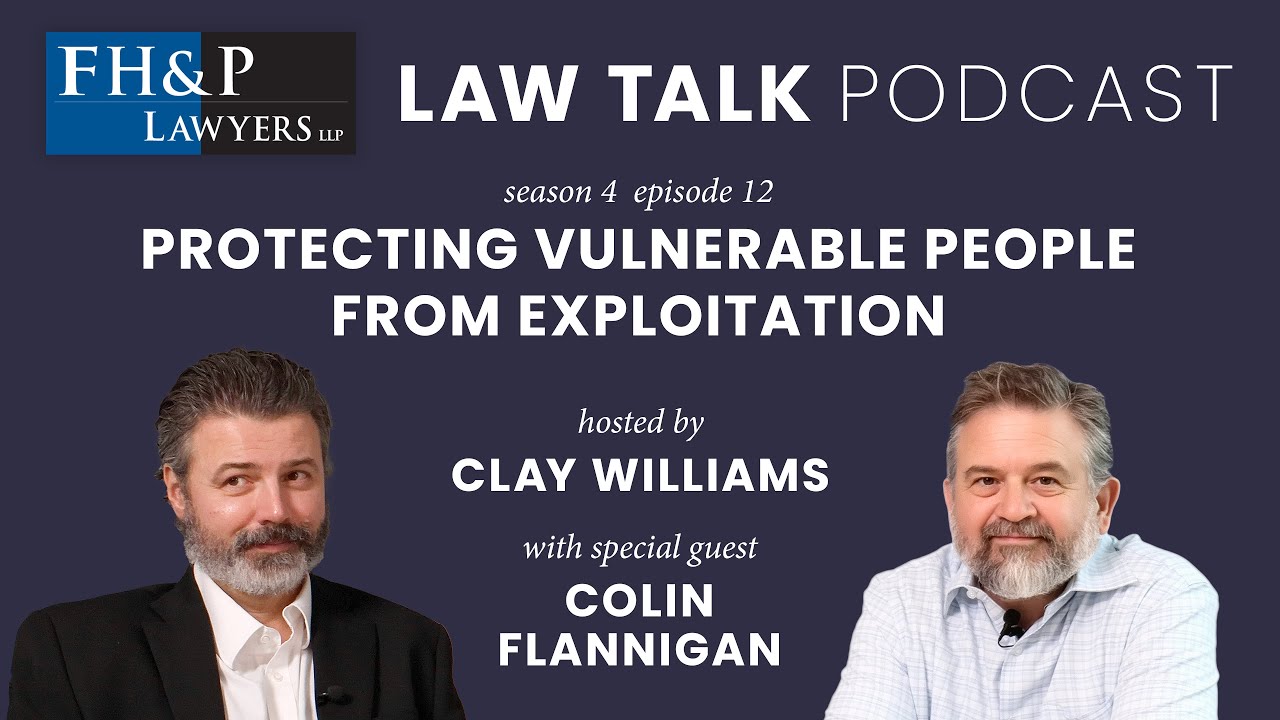
What happens when someone you love is still technically capable, but clearly making dangerous or questionable decisions? On this episode of Law Talk, FH&P Lawyers’ Clay Williams speaks with Colin Flannigan about powers of attorney, representation agreements, and the real-world limits of the law when it comes to shielding vulnerable adults from financial and emotional exploitation.
Clay: Welcome to Law Talk. I'm Clay Williams. I'm a partner at FH&P Lawyers. We have Colin Flannigan with us today, and we have a great topic. We're going to talk about how to protect vulnerable people from being exploited. It’s a serious topic. Before you start, I want to say to our listeners that I’ve found this has been a real help—numerous clients have asked about what they can do when they see signs of exploitation.
It’s usually their parents who are having some mental decline, if that’s the right word, and are making questionable decisions. Of course, they’re really worried about their loved ones and what they can do. Colin, you’ve been a real help in explaining what they can or, unfortunately, what they mainly cannot do. You are the person who really knows the law in that regard.
Colin, you do a lot of estate and adult guardianship cases. Usually, from my perspective, I get a call, and it will be, “My father is making really poor decisions.” I’ve had a situation where a father lost his license and went down and bought a car. That made me upset. I thought, what car dealership is selling a car to someone who does not have a license?
Those are usually how I get involved, and I will say, “Talk to Colin.” So tell us about some of the background of the law and what you can tell people who are concerned that their loved ones are being exploited.
When “New Friends” and Strange Spending Start to Raise Red Flags
Colin: One of the big things with this is that it’s not just about erratic behaviour, but also how it impacts other people. Some of the questions are about new friends or interlopers who are spending time with Mom or Dad now, and where some of that money is being spent. The first thing to think about when it comes to capacity and guardianship is that there are no perfect answers, because many people feel there are gaps in how people can be looked after.
The first concept is capacity. Losing capacity, or even before that, having capacity for different things involves different types of capacity. The ability to buy a car and have enough capacity to do that is not necessarily the same level of capacity needed to execute a will or power of attorney.
Capacity can be complex, especially in waning capacity situations. For some people, the loss of capacity might be from a traumatic brain injury—getting in a motor vehicle accident, or something like an aneurysm. But for the vast majority of people with capacity concerns, it is not a light switch. It is more of a waning scenario, especially when it is degenerative in nature.
Capacity Is Not a Light Switch: Understanding Waning Decision-Making
Colin: It is not a straight line down. It is more like a ship on the seas—ups and downs, good times of day and bad times of day. Just because a parent may not have had capacity one day does not mean they will never have a lucid moment again. They may be entirely lucid when they show up at the car dealership the next day and have the ability to execute a contract to purchase a new Audi, even though they have no driver’s license.
That is the first thing to understand: it’s not a simple situation where it is all black and white. There is a lot of gray here. When looking at the gray, the first concept is: how do we plan for it in the first instance? If we are planning to make sure we have documentation in place in case we eventually lose capacity ourselves, usually we are looking at things like a power of attorney for legal and mostly financial decision-making—paying bills, filing tax returns—or health care decision-making, often done as a representation agreement. That is usually how the pre-planning works.
The problem is that later in life, even if people have granted their kids a power of attorney and representation agreement, they may now have a new friend or caregiver. That new caregiver may be trying to take them to different lawyers or notaries to get new powers of attorney or representation agreements granting control to the new friend. That gets really difficult for the kids—
Clay: —And one of the important roles for lawyers is to act as a gatekeeper in that situation.
Lawyers as Gatekeepers Against Undue Influence
Colin: As lawyers at FH&P Lawyers, that is something we have to be very careful about. I know as a lawyer, when someone comes in who is not a client of mine and is a new client the firm has never dealt with before, and they are brought in by a friend, it raises red flags. That does not mean something improper is happening—it might be completely aboveboard—but it could also be something untoward. Lawyers have obligations to do due diligence, to make sure the person has capacity. It is not just whether they know who their family members are and what their assets are. That is important for testamentary capacity, but powers of attorney and health care decision-making have other capacity tests.
We also have to ask about undue influence: who are you naming and why? Why are you naming this new friend or caregiver? Do you want to add them to your will? Lawyers are obligated to test for that. Sometimes lawyers are pressured into doing it. I have even talked to people asking, “Are you being pressured here? Are they saying they will not care for you anymore if you do not do this?” And sometimes the person says, “Yes, they are the only person who takes me anywhere.”
Sometimes you have to get creative—such as making a will that gives the caregiver a gift, then immediately executing a new will that revokes it and reflects the person’s true intentions. That way the caregiver thinks they will receive the gift and will continue helping, but the real will reflects the client’s wishes, so they’re not being unduly influenced.
Planning Ahead: Powers of Attorney and Representation Agreements
Clay: So, the first level or step is setting this up in advance. If I am getting older and may have some mental decline, I should have things in place. But that does not mean I have lost control of my money, does it? Even though I have executed a power of attorney and named one of my kids as a holder, that does not mean I cannot go to the bank or buy a car.
Colin: There are two sides to that coin. A person giving a power of attorney may not be ready to give up all authority. If people give up too much authority, they sometimes withdraw, and that can have a negative impact on their health. So someone granting a power of attorney may still want to be involved in decision-making.
But on the flip side, they might still go buy that new Audi even though they lost their license. Giving the power of attorney does not take away the right to make their own decisions. There is a difference between eccentric behaviour and spending money unwisely. It is their money. If they are not being unduly influenced or coerced, they are entitled to make a poor decision.
Clay: You can also choose not to give up the power of attorney immediately. You can put it in place, but decide not to activate it yet. That is good advice. Everyone should have a power of attorney.
Colin: Representation agreements are also very important, especially for end-of-life decision-making. It is a very personal decision. Having someone who can make that choice ensures you are not kept alive in a situation you would not want. If you are in a permanent coma and your heart stops, would you want cardiac resuscitation or intubation? Having someone who knows your wishes makes it easier. If a child is in the hospital with a parent, having advance wishes written out makes the decision easier.
Clay: I did not mean you should not have a representation agreement—I just meant it may not be the most important document for someone facing declining mental capacity in terms of exploitation by a new actor. But representation agreements are still important.
Colin: Yeah, if someone is experiencing waning capacity, a representation agreement gives someone access to medical records and information from doctor’s appointments.
Gaps in Guardianship and the Patient’s Property Act
If a new friend is involved in their life and there is a representation agreement in place, if the family is unsure, they can discuss concerns with the doctor.
Clay: What can be done in these types of situations?
Colin: That’s the problem. Unless someone reaches the point of incapacity, not just waning capacity—where a court order under the Patient’s Property Act declares someone incapable of managing themselves or their affairs—options are limited. The threshold is significant. It requires two medical opinions in open court that the person cannot manage their finances or themselves. It is a high threshold. There can be a long period between when someone begins showing concerns and when they meet that test. That is where people feel there may be gaps in guardianship legislation. Unless someone is involuntarily committed—usually temporary and often related to psychological issues—there can be many situations where vulnerable people fall into a gap.
The Role of the Public Guardian and Trustee (PGT)
Clay: Is there someone people can call? A government agency that could get involved in exploitation cases? I'm not talking about the somewhat unethical car salesman. I'm talking about the situation like a new friend who's come, moved in, maybe. And this is my friend who drives me everywhere. Is there anything that can be done?
Colin: In that type of situation, sometimes the entity that people will talk to is probably most often the public guardian and trustee's office, the PGT, and they've got a pretty wide ambit for different areas. One of their roles is looking into concerns about vulnerable individuals being exploited. They may receive referrals from friends, neighbours, or banks who’ve seen untoward things happening. Banks sometimes act as gatekeepers, raising concerns when they see exploitation.
Clay: Every day you read a story about an elderly person being scammed—something pops up on a computer, they call a number, and get scammed.
Colin: That is one form of exploitation. Another is when someone’s ability to make decisions is impaired due to incapacity or undue influence. In these cases, the Public Guardian and Trustee can act as a public committee of someone’s estate, handling finances if they are declared incompetent.
The process is usually quicker and easier than obtaining a private committee order. It does not require two medical opinions; it requires a certificate of incapacity from the local health authority. It can be quicker, especially when fraud is ongoing.
Often the first call is to someone like me—a lawyer—saying, “This is what is happening. What can I do?” My job is to walk people through the options. There is rarely a perfect answer. The best option depends on the facts.
Clay: So, to summarize: help yourself by making sure you have proper estate planning documents in place—
Colin: Yeah, appoint people you trust who will look out for you.
Who Should You Name as Attorney? Trust, Risk, and Professional Options
Clay: What about people who never had kids or have nobody?
Colin: Sometimes people ask who they can name as a power of attorney. It has to be someone they trust deeply, because powers of attorney can be abused. Sometimes it is siblings, nieces, nephews, or younger generations. Sometimes people look further afield to neighbours, but that can be concerning because it is a different level of trust. Some people choose professional trust companies—it is not cheap, but you get what you pay for.
So, pointers for our audience here: If you know someone you are worried about, sometimes you need to have frank conversations and ask if they have their plans in order. As long as they can still make the choice themselves, it is easier to do the documents. If you leave it too late and no longer have capacity, you may need the public trustee or a private committee, which can cost thousands and take months. It does not help anyone if you have lost capacity and do not realize it.
Colin: The big takeaway: set up your own plan. And if you know someone who is starting to struggle, check with them and make sure they have a plan as well.
Clay: Fantastic! We are really lucky to have you, Colin. Thank you, and thank you for answering my clients’ questions when they come up. Basically, get an estate plan if you do not have one. This is FH&P Lawyers, until next time.
As Colin explains, there is no perfect fix, but early planning, carefully chosen decision-makers, and knowing when to involve professionals can greatly reduce the risk of exploitation. If you have concerns about a loved one’s capacity, undue influence, or need help putting powers of attorney or representation agreements in place, the team at FH&P Lawyers is here to provide clear, practical guidance.
Disclaimer: This material is provided for informational purposes only and should not be construed as legal advice on any subject matter. Consult with a qualified lawyer for advice on specific legal issues.