Civil Litigation & Personal Disputes, Employment Law, General Litigation, Radio/Media
What Every BC Employer Should Know About Workplace Investigations
July 30, 2025 by Brett McClelland, Clay Williams
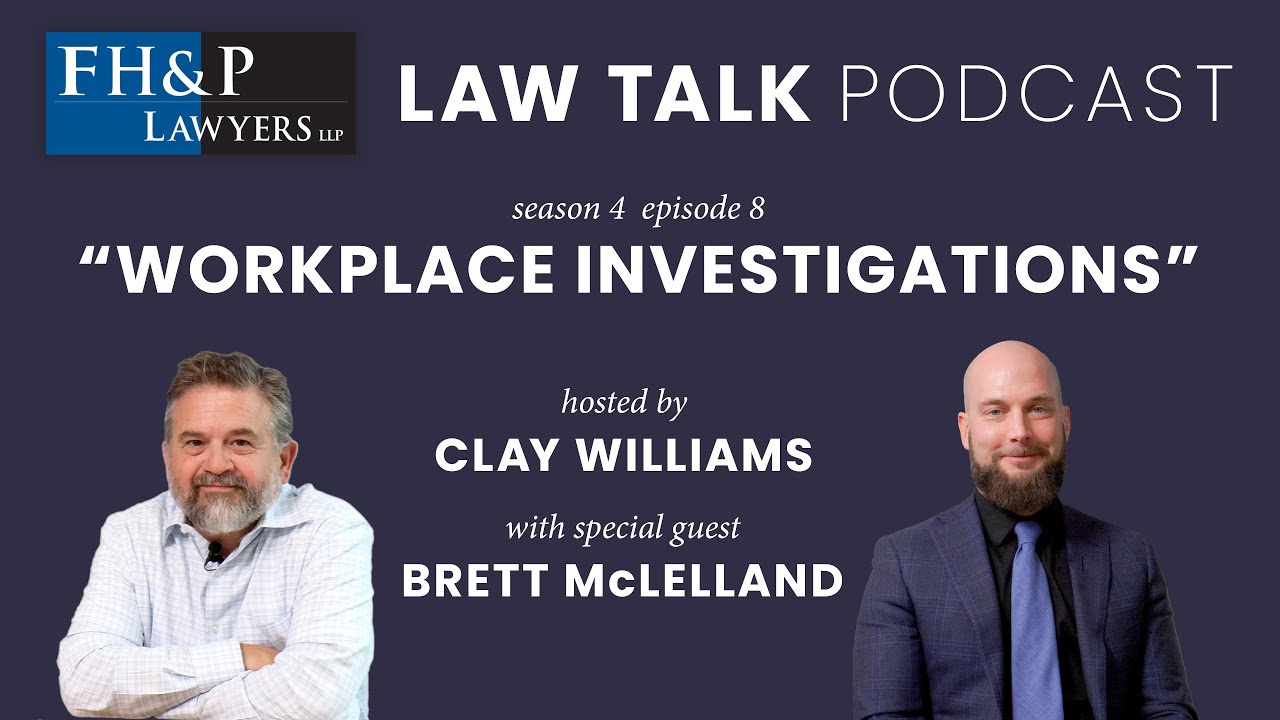
When do workplace issues cross the line into legal territory? In this episode of FH&P Lawyers’ Law Talk Podcast, host Clay Williams sits down with associate lawyer and certified workplace investigator Brett McClelland for a candid conversation about the legal realities of workplace investigations in today’s evolving business landscape.
From toxic work environments and mobbing, to social media missteps and remote work grey areas, Brett breaks down when—and why—employers must take action. Drawing on real-world examples (and a few war stories), this episode explores how to handle internal complaints, avoid common investigation pitfalls, and why bringing in an independent investigator might save more than just face.
Whether you're an HR professional, business owner, or team leader juggling multiple roles, this episode delivers sharp insight and practical tips to help protect your team, your culture, and your company.
Clay: Welcome to another edition of FH&P Lawyers Law Talk. I am Clay Williams, and I'm a partner here at FH&P Lawyers. I'm here with Brett McClelland today, and we are going to be talking about workplace investigations. Just so our listeners know, through Brett, we have partnered with BC Freestyle and become a sponsor. It's been an interesting journey. So, what are we sponsoring right now?
Brett: We're doing the Okanagan Shred Sessions, which is a regional series. Honestly, I couldn't have been more impressed with the level of commitment from the athletes, the coaches, the volunteers, and the firm. It really went off quite well. Everybody was super stoked, and they're hoping to gear up for another one.
What Is a Certified Workplace Investigator?
Clay: Alright, so we are talking about workplace investigations today, and it's kind of new for us, just like our association with BC Freestyle. You are a certified workplace investigator?
Brett: Yes, that's correct. I took the Advanced Certificate in Workplace Investigations through Osgoode Hall, which is the law school at York University in Toronto. It's a very, very highly regarded course. It was a lot of work, very informative, and with that, I'm now certified to do workplace investigations. Just get a little more background on the nuance and some guidance from people who have conducted workplace investigations in some of the most intense and fraught situations, which ideally you don't want to be handling on your own as a small, medium-sized, or even a large business owner.
Clay: Any business, yeah, I would think.
Brett: The amount of time and effort you have to put into actually doing a thorough and proper workplace investigation would mean you are not taking that time and energy and putting it towards running your actual business.
When Employers Have a Legal Duty to Investigate
Clay: Let's start here, just so our listeners understand. There are certain instances, I guess, where an employer has a duty to actually start an investigation. Why don't we start there?
Brett: A general guiding principle in any workplace investigation is that an employer owes a duty to see that the work atmosphere is conducive to the well-being of its employees. Obviously, that's a pretty vague and broad definition, so there are a lot of things that are going to fall under that.
Clay: Is that like WCB or what? That's just WorkSafe now?
Brett: Yeah, and it comes out through case law and the BC Human Rights Code, or depending on what organization you're in, you might fall under the Federal Human Rights Code. And then there's the common law that has expanded upon that—what you should be expecting of your workplace when you go to work. So when somebody is dealing with things like bullying, that would fall under the umbrella term of harassment. And then there are different shades of harassment. Are you just being overly sensitive? Is it a performance-related thing that's coming your way? Or are you being targeted, ostracized, or essentially bullied?
A common thing that's coming up these days, not only in the workplace but also at school, is what is called mobbing, where you have a bit of a ringleader who picks on somebody. It looks very similar to schoolyard bullying. The impacts are much more damaging, though, because it's your ability to earn income. All of a sudden, you can't go to work and feel safe and bring money home to your family, pay your bills, because you're being harassed endlessly at work.
Clay: So this sounds like WorkSafe stuff. I guess the point to start, or the point I want to make first, is, as I understand it, an employer has a duty to investigate when an employee makes allegations that they are being bullied or harassed or mocked?
Brett: Whether you've been served with a formal complaint from one of your employees or a formal grievance, or you just caught wind of it, as soon as you know that something might have happened, you have a duty to investigate it. If you don't, not only are you potentially liable for the poisoned work environment, toxic work environment, or whatever else is happening, but you also might be liable for failing to take any steps to address it, investigate it, and take action to prevent that from happening to that person or to anybody else in your organization going forward. So yes, you have a positive obligation to investigate and a positive obligation to make sure that you have offered your employees a safe work environment.
Internal vs. External Investigations: What to Consider
Clay: And so to start, I understand that most of these investigations—you tell me if I'm wrong, okay—but I understand most of these investigations are done in-house or done internally?
Brett: A lot of the time ,you can get away with doing an in-house investigation. One thing you want to think about is how big your company is? Do you have a policy in place that says—
Clay: We have to have a policy in place now?
Brett: What you have to do and what you actually do are very different.
Clay: That's true.
Brett: I think we can appreciate that as litigators. Yes, you should have a policy in place, and your policy probably has something about it being a safe workplace and what you need to do if you have concerns.
Clay: And who to—if I'm an employee—who to report to, exactly how I can expect it to be.
Brett: Depending on how big the company is, you might have somebody who's the HR person who’s also responsible for the accounting side of things and just running the office or business itself. But that person might, when you're doing an investigation, come up into the very awkward scenario where you're investigating somebody you're very close with—
Clay: Or yourself, all bad too.
Brett: Exactly.
Clay: If the allegations are against the person who usually does the investigation, I would think that’s a problem.
Brett: When you're thinking about whether or not you should just do this in-house or retain somebody outside, there are things you should always think about. You should think about the nature and the severity of the complaint, the people involved, the time and expense that is going to have to go into you conducting the investigation versus anything else, and whether or not you actually feel competent and capable of doing that investigation thoroughly enough that you get to the bottom of the actual issue. There are lots of nuance that goes on with harassment.
Types of Workplace Harassment and Legal Complexity
Brett: There are different types of harassment. We kind of touched on that before, where it could be just what one might consider more standard workplace bullying or schoolyard bullying, and then there's full-on targeted attacks, which can escalate into violence. You've got sexual harassment that falls under that, and that doesn't always have to be physically laying hands on somebody. It can be just inappropriate comments, jokes, innuendo, quid pro quo, or just unwanted attention.
Trying to differentiate what is actually going on can be very cumbersome if you are not apprised of the law behind what you're trying to investigate and what your actual requirements are. Because your company policy—ideally, you have one—that will dictate the top level, but then you'll also want to understand any employment standards, any WorkSafe requirements, and any human rights requirements. Sometimes you get into discrimination.
Conflicts of Interest and Confirmation Bias
Clay: I always tell my clients it's tough to be an employer nowadays. There are a lot of rules. I think what you're saying is, look, you have a duty to investigate. Obviously, there are conflicts of interest—can't investigate yourself, shouldn’t investigate somebody you're really close with, I guess. But also whether you feel confident or competent in doing that. That's a good point. Especially in smaller companies, that's a burden. It's an expense. But having said that, if you're wearing many hats, maybe that's the right way to do it. Because if you don't, what happens?
Brett: Well, you probably won't get to the heart of the matter. You won't actually address the impetus of the complaint. What might happen is something that could have been very easy to nip in the bud, turns into a full-blown, poisoned or toxic work environment, which almost assuredly will end up with you being liable for any damages that the original complainant has suffered.
Clay: Not just damages in the sense of litigators thinking about that, but also with statutory regimes like WorkSafe.
Brett: Exactly. You're going to have issues with workplace culture. Just leave aside the legal stuff for a minute. All of a sudden, you have somebody in your small firm making a complaint about one of your managers. You and the manager go back decades. You decide to do the investigation yourself. You're going to have issues because you have some confirmation bias. You're probably going to be looking for justifications as to why your manager friend did what he did. You're probably going to look at him in a different light than what the complainant is saying.
You might not come at it as objectively as an outside person would. You might ask the wrong questions. You might ask the right questions, but in the wrong way. As part of a proper investigation, you will have to ask very awkward and uncomfortable questions sometimes.
Clay: That confirmation—I'm going to jump in and just tell war stories here—but that confirmation bias, that's very interesting. I've seen it. I've done it in court cases where we have two experts look at the same set of facts, and they come to completely different conclusions. They've gone into it expecting to see something, and that's what they find. Very, very interesting stuff.
Where Does the Workplace Begin and End?
Brett: One thing I think that, nowadays in 2025 and the wonderful world we live in, gets challenging for a lot of businesses is: what is the workplace? When do I have to investigate a complaint? Do I have to worry about what my coworkers or employees are saying to each other in a social media chat?
The thing is it depends. Depends hon ow the social media chat arose. Are you talking about work in there as well? Are you talking about coworkers in a demeaning way? I'm sure we've all heard the horror stories about that. I know the RCMP and Armed Forces have had to deal with a few of those chats that have come to light.
What about a couple of coworkers just going out for drinks? When do you, as the employer, have to step in and do an investigation if your coworkers have just gone out for drinks? Depends. Were you going out to celebrate a birthday for another coworker, and the firm shut down, and everybody went out? Or did they just decide to go out and have some drinks as friends slash coworkers?
Clay: A workplace event as opposed to—
Brett: Yeah. What if they're just working from home? Does the workplace extend to their house? It can, depending on what's happening. What about a work-related conference? If you, as the employer, send your employee to a conference or a training exercise and somebody who is not your employee harasses them or does something to them, do you have a duty to investigate?
Clay: I actually need to know the answer to that.
Brett: Yes, you do. You very much should.
One of the stories that came up—the investigator kind of posed that exact scenario as an exercise for us to work through. The variety of responses we got was amazing because we were involved with people from all varying backgrounds. We had HR professionals, lawyers, cops, ex-Crown prosecutors, and everybody had a different spin on it. But what the instructor told us is that he had that exact scenario where an employer had sent a couple of female staff to an overseas conference. They got relentlessly harassed, borderline sexual assault, came back, and he was told about it. His response was to send only men the next year, and the women got to stay home and go out for dinner with him, which, on so many levels, offended a lot of people.
The real moral of that story is you should probably have investigated that with an independent person originally, because your proposed solution just threw fuel on the fire. He ended up getting more complaints out of it. Instead of just dealing with the two people who had to deal with that issue at the overseas conference, he now had all of the women saying he was discriminating against them and being sexist.
Brett: Because his response was, “I'm going to send them on a multi-thousand-dollar trip to Europe while I take you out for dinner.”
Clay: Yeah, that's a conundrum. I could see he's trying to keep them safe, but at the same time, leaning into another issue.
Brett: Exactly. As they say, no good deed goes unpunished.
Why Independent Investigations Matter
Clay: So I guess, if an employer is faced with a complaint like this, they can always call you and discuss it before engaging with you?
Brett: Exactly. Sometimes just a second set of eyes on a situation helps, especially when they're an objective person. I wouldn’t know anybody beforehand, and that's one of the beautiful things about being an independent investigator. I can go in, ask all the tough questions, and then give my report. I leave. I don't have to worry about my asking questions of a coworker causing them to quit, and then potentially having issues with retaining staff because there’s a division in the workplace.
You get an "us versus them" mentality. Or, “Are the managers even looking out for us?” Then you have to deal with problems forevermore, where you now have a reputation in your community that you have not only hired people who might be harassing staff or discriminating against staff, but then you did an investigation, which—almost assuredly—somebody’s going to call a cover-up. Now you’ve got to try and deal with that issue.
What to Expect During the Investigation Process
Clay: A flawed investigation, yeah. Brett, tell me—talk to our listeners here—about the process itself. Are you going into business? It seems a little disruptive, I guess. Or do you do it by video? How are you talking to people? I mean, I guess some of the stuff you can look at in your office—policies and that kind of stuff—but how do you deal with witnesses?
Brett: That's a great question. You kind of touched on it earlier—the generational divide. It really depends on what the witness feels comfortable doing, what we’re talking about. I'm not going to want to take somebody to a coffee shop and discuss their sexual harassment claim—whether they were the complainant, the respondent, or a witness—or whether we just do that by a video call or a phone call. There's a lot of nuance, especially depending on the severity of the complaint.
Clay: Is part of that the consideration cost? It seems to me it would cost more for you to go into a workplace and investigate or do interviews in their boardroom—but that might not be appropriate anyway—than maybe doing a video call. Is that something you talk to the potential client about?
Brett: Exactly—and also the witness. If we take the most severe of cases, you want to make the witnesses, the complainant, the respondent—everybody—feel comfortable and heard.
I've done a lot of work with trauma-informed investigations, not only through my work as a lawyer but also in investigations. That comes up quite a bit—how to properly get information out of a witness when they’ve been in a traumatic setting. Putting them at ease is the only way you're going to get anything useful. You can get the answers you want, what you think are the right answers—but have you asked the right questions? Were they feeling safe, and like you were actually going to be listening to them?
I know we've all been in those conversations where it feels like the other person is not hearing you—they’re just waiting for their chance to talk. In a proper investigation, all of the witnesses should understand: you are just there to do one thing and one thing only—find out what happened. You're not going to be making legal findings as if you're in a court of law.
Clay: Well, are you? I mean, you have to come up with the results of your investigation.
Brett: Yep.
Clay: What does that look like at the end of the day? You are preparing a document, I take it?
Brett: Yep. And you don't always have to prepare a report. Again, it depends on what the client is comfortable paying and what the severity is. Sometimes you can do it pretty quickly in a one-page letter or just have a quick phone call with the employer. Other times, you’re probably going to have to do a very lengthy report. You’ll have to break it down, complaint by complaint. You’ll have to compare it to the policy and any other law that might be engaged, and make a finding of fact, which then can be used in a court of law as part of an investigation.
Brett: That’s where an independent investigator has to make sure it’s going to stand up. Because whether you're an employer or an investigator, somebody is probably going to say this is a cover-up. “This is bogus. You didn’t actually investigate any of my evidence or complaints.” “You’re incompetent.” That’s one that’s always thrown around.
Inevitably, in every investigation report you come across, somebody's calling somebody incompetent. That is when the training and the process you follow—which should be explained to each witness ahead of time—really comes into play. Because there are things we’re looking out for as an investigator.
If everybody’s saying the exact same thing happened, that’s weird to me. That gives me a whiff of collusion, because everybody talks differently. You play the telephone game for five people, and it’s a completely different story by the end. But if everybody's telling me the exact same thing, that hints there might be issues with the reliability and credibility of a witness’s recollection and testimony.
Common Employer Pitfalls and How to Avoid Them
Clay: Our marketing director has told me, “Make sure you ask him this one. Listeners want to know this.” Common pitfalls and how to avoid them. I think what she must be talking about is: for employers, what are some common pitfalls? And if an employer has that duty—now we've got an investigation—what are some things they better consider, and how can they avoid those things?
Brett: Timeliness. You want to make sure you address it quickly. You want to make sure you're thorough. And by saying timeliness and thoroughness so closely, you want to make sure they’re in sync. Because doing a very quick investigation—while possible—might not lead to the most thorough investigation. Almost assuredly, you’re going to ask one witness if there were any other witnesses, and then you’ve got to follow the chain to verify things.
Brett: You're always looking for the best evidence. Do you have emails? Do you have letters? Do you have a video? Anything like that. If not, then you go down the chain and try to find people who can verify what one person is saying versus what another person is saying.
You want to make sure you're acknowledging what we talked about earlier—your own personal biases. That’s something you should be aware of. You might slip into trying to find in favour of the person you like more or have known longer. Or the classic example: Bob's two years away from retirement. You're going to completely ruin his career if it comes out that he had sexually harassed or bullied someone at work, or if he might be discriminating against people.
You want to try and be cognizant of any myths and misconceptions about certain types of people. We kind of already joked about it—Zoomers being overly sensitive. Is that a myth or a misconception?
Clay: Or a bias on my part?
Brett: Exactly. Those are things you need to be thinking about. And the always tough—and I think a lot of lawyers struggle with it—credibility versus reliability. You can firmly, to your core, believe something is true and it can be completely false. You are not an uncredible witness—you’re just an unreliable witness. How do you determine that?
Clay: Thank you, Brett, for telling us all about workplace investigations. This is an important topic. If you've got any questions, if you need any assistance, reach out to us, until next time, thanks for listening!
From handling sensitive complaints to protecting workplace culture, conducting a fair and thorough investigation isn’t just best practice—it’s a legal obligation. At FH&P Lawyers, we’re here to support employers with practical, informed guidance that balances compliance, risk management, and employee wellbeing.
If you’re facing a workplace issue or just want to strengthen your internal policies, connect with our team to learn how we can help. Because when it comes to navigating complex employment matters, trusted legal insight makes all the difference.
Disclaimer: This material is provided for informational purposes only and should not be construed as legal advice on any subject matter. Consult with a qualified lawyer for advice on specific legal issues.