Insurance Law, Radio/Media, Real Estate - Residential
What Okanagan Homeowners Need to Know About Wildfire Insurance
September 21, 2026 by Clay Williams, Darren Kautz
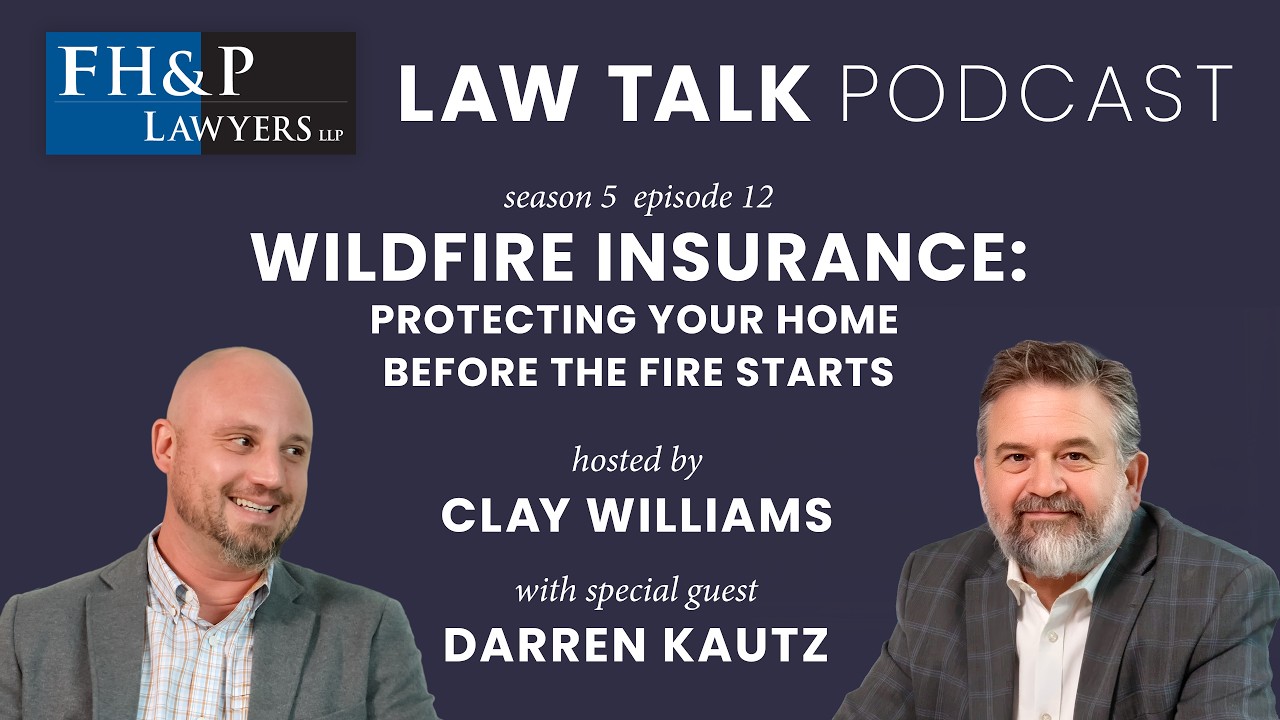
Wildfires have become an almost yearly reality in the Okanagan, and with them comes a set of insurance questions most homeowners never think about until it's too late. In this episode of FH&P Lawyers' Law Talk, Clay Williams speaks with Partner Darren Kautz about how wildfire insurance policies actually work, what they cover, and what homeowners should be doing now, before smoke is on the horizon.
Why Is Wildfire Insurance Such a Pressing Issue in the Okanagan Right Now?
The Okanagan has seen back-to-back major wildfires in recent years. The Bradley Creek Fire affected the North Okanagan and damaged or destroyed 245 structures. Not long before that, the Summerland fire damaged or destroyed 150 structures and forced roughly 2,000 people out of their homes when the entire community was evacuated. It has been about three years since the last major fire in 2023, and now the region is dealing with another one. These events are becoming more frequent, and Darren Kautz notes he personally knows people who were evacuated from Summerland and others whose cabins burned down in the Bradley Creek fire this year.
Can You Get a New Fire Insurance Policy Once a Wildfire Has Already Started?
No. Once a fire starts in the valley, you cannot get a new insurance policy, switch providers, or even renew an existing policy. This is one of the biggest things homeowners get wrong: insurance needs to be arranged well in advance of fire season, not once smoke is visible.
What Kinds of Losses Can a Wildfire Actually Cause Beyond a Total Loss?
Total losses, homes burning completely down, get the most attention, but there is a lot more to wildfire damage than that. One of the biggest sources of damage is actually the remediation process itself. When air tankers drop fire retardant, a pink foam, on a property to help stop a fire or create a barrier, that foam can cause serious damage to siding and roofing, and often it cannot simply be removed. In many cases, this means replacing an entire roof. Beyond retardant damage, homes can suffer smoke damage and water damage from firefighting efforts, even when the structure itself never catches fire.
Does Home Insurance Cover Fire Retardant Damage to Your Roof?
Usually, yes, but it depends on the amount involved, and replacing an entire roof is a significant bill. Coverage can also shrink as a roof ages. For policies where the roof is aging, insurers often reduce the amount they will pay out if the entire roof needs to be replaced. The likelihood of an entire older roof being fully covered is low, so it is worth checking your policy to see exactly how much of your roof is actually covered. We can definitely help with advice on your home insurance policy.
Can a Wildfire Damage Your Foundation Even If Your Home Never Burns?
Yes. When a wildfire burns through an area, the ground itself can shift and move as tree roots burn away. Because the Okanagan is a valley, many homes are built on slopes, and if the trees behind a property burn, the root structure that holds the surrounding soil in place is gone. That can lead to soil sloughing and cracked or destroyed foundations, even in homes that were never touched by flame.
Is British Columbia Facing the Same Insurance Crisis as California?
Not yet, and that is some genuinely good news. In the United States, insurance programs are structured differently, drawing on a large shared fund that supports coverage nationwide. When that fund starts to be depleted, insurers either refuse to provide additional wildfire coverage or become unable to pay out further claims, as has happened in parts of California. Insurance in Canada operates under a more secure framework, so at this point, there is no issue with being unable to insure a home due to wildfire risk.
Are Insurance Premiums Going Up While Coverage Goes Down?
Yes. While most policies still cover fires and the incidentals that can result from one, insurers are increasing rates while slowly decreasing coverage in certain areas.
What Are Additional Living Expenses, and What Do They Actually Cover?
Additional living expenses cover new costs you incur while you are out of your home, not the value of what you left behind. For example, if you are evacuated and have a fridge full of groceries at home, your policy will not reimburse you for that food. It will cover new purchases you have to make while displaced, but only up to what you reasonably require. If you had a big weekend planned and just bought a few hundred dollars' worth of steaks before being evacuated, those steaks spoiling over the following months are not covered, and you will not be reimbursed for steak dinners while living in a hotel either. Insurers will cover the basics while you are out of your home, but not the cost of everything you would have eaten or used there.
What Is Under Insurance, and Why Does It Matter?
Underinsurance is a major issue right now. Replacement cost for home building has climbed to roughly $400-$500 per square foot. A home built in the 1980s or 1990s may have cost $100-$150 per square foot at the time. If your policy is based on your home's assessed value rather than true replacement cost, and that assessed value is, say, $1 million, the likelihood you could actually rebuild your home for $1 million is very low. Assessed value is a figure the government uses for taxation purposes, and with building code changes and rising construction costs, it is not a reliable indicator of what it would actually cost to rebuild.
Having a builder walk through your home and provide a real cost-per-square-foot estimate can help you understand how much coverage you actually need when talking to your insurer or broker. It may feel like a broker is upselling you when they suggest increasing your coverage, but your house is likely the biggest asset you own, and this is one area worth spending the extra money to get right.
Can Insurance Companies Restrict Coverage by Postal Code?
Yes. While British Columbia has not seen an entire province or region lose access to wildfire insurance, as parts of California have, insurers are now applying postal code restrictions in specific high-risk areas. West Side Road is one example where homeowners should double-check their insurance status. If you are purchasing a home, especially your biggest asset, it is worth doing your due diligence on whether insurance is even available for that postal code before you buy.
When Is the Best Time to Renew Your Home Insurance Policy?
Not in the summer. Trying to renew or newly arrange a policy during fire season is not a good idea, since insurers may be unwilling to write new coverage once fire risk is active in the area. This is part of why BC's standard real estate contracts now include a force majeure clause that extends timelines if a buyer is unable to obtain insurance during the transaction.
What Is Guaranteed Replacement Cost, and Why Should You Ask for It in Writing?
Guaranteed replacement cost is worth asking for explicitly and getting confirmed in writing, so you know exactly what your policy promises, including whether it covers rebuilding on the same lot and what the specific terms of that guarantee are.
How Can You Document Your Personal Property Before a Wildfire Happens?
Taking photos and videos of everything in your home and uploading them to the cloud is one of the simplest ways to protect yourself. One FH&P Lawyers client had his tools destroyed in a house fire, and the receipts for those tools were sitting in a box in his own garage, which also burned. High-value items like jewelry can also be added as special scheduled items on your policy. Categorizing your belongings in advance with your broker and insurer is the easiest way to avoid disputes later. By the time people come into a lawyer's office over a coverage dispute, they are often already at the point of a fight with their insurer over what is or is not covered. Trying to remember everything that was in your jewelry box or garage from memory, after the trauma of losing your home, is extremely difficult, and independent adjusters can only value what you can actually show them.
What Is a FireSmart BC Assessment, and How Can It Help?
FireSmart BC offers free assessments that look at things like clearing trees back from your home and removing combustible materials from your property. Getting one done can help you qualify for insurance discounts and address underwriting issues down the road.
Does Your Roofing Material Affect Your Fire Risk and Insurance?
Yes. Wood or cedar roofs, once common in the Okanagan, can go up like tinder, which is why they are far less common today. Tin roofs became popular as fires grew more common, but tin can actually be damaged more severely by heat than some other materials, with warping and screws working loose over time. Even aluminum roofing, though generally long-lasting, is not immune to fire-related damage, such as warped seals around screws. Replacement costs for any roof type are high, which is part of why roofs come up so often in wildfire insurance discussions.
What Is the Two-Year Limitation Period, and Why Does It Matter So Much?
British Columbia has a two-year limitation period for insurance disputes, and it is one of the biggest problems Darren Kautz sees in his practice. People often wait, sometimes until a year and eleven months have passed, before reaching out about a dispute with their insurer. At that point, it becomes a frantic scramble to file a civil claim in time to preserve the right to make a claim at all. A limitation period cannot be extended, so even if a delay is not the insurance company's fault, homeowners need to act before it expires or they risk losing their right to claim entirely.
Delays are not always the insurer's fault either. After a major disaster, there are only so many adjusters available, and each one may be assigned hundreds of files at once, which naturally slows down response times. Still, the two-year clock keeps running regardless of how busy adjusters are, which is exactly why it should not be left until the last minute.
What Is the Single Most Important Takeaway for Homeowners?
When a fire is on the horizon, it is not the time to check your policy or figure out what you actually own. Preparation needs to happen in advance, before wildfire season, not during it.
Talk to FH&P Lawyers About Your Wildfire Insurance Questions
Wildfire insurance in the Okanagan is not just about whether your home burns down. It covers everything from retardant damage and foundation issues to underinsurance, postal code restrictions, and strict filing deadlines if a dispute arises. Reviewing your policy before fire season, documenting your property, and understanding your limitation period could make all the difference if the worst happens. If you have questions about your home insurance coverage or a dispute with your insurer, contact the team at FH&P Lawyers. We can walk you through what applies to your situation.
Disclaimer: This material is provided for informational purposes only and should not be construed as legal advice on any subject matter. Consult with a qualified lawyer for advice on specific legal issues.