Insurance Defence, Insurance Law, Radio/Media
Travel Insurance Denials: How Medical Records Can Affect Your Claim and What to Do Next
January 23, 2026 by Clay Williams, Wendy Cheung
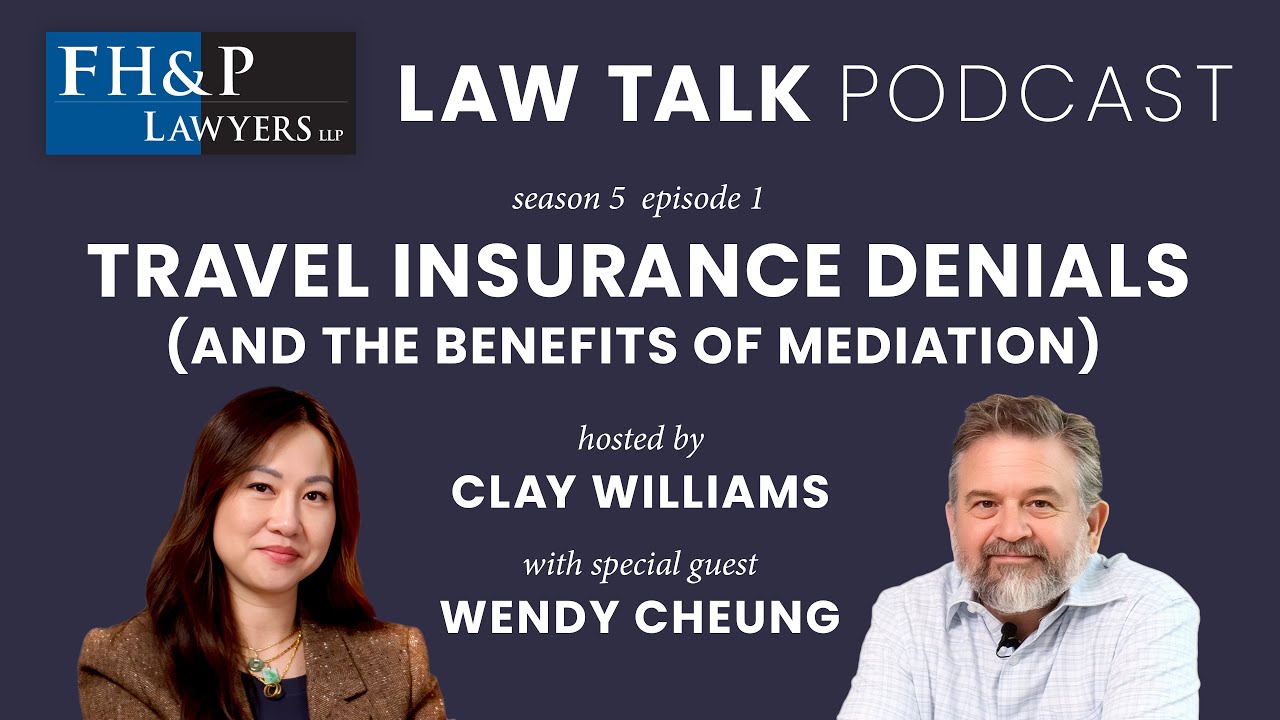
What happens when you do everything “right,” buy travel insurance, fill out the forms, and still get told your claim is denied?
On this episode of Law Talk, FH&P Lawyers’ Clay Williams sits down with Wendy Cheung to unpack why travel medical claims get rejected, how insurers use old medical records to revisit application answers, and how a smart, solutions-first negotiation strategy can turn a six-figure denial into a full payout without going to court.
Clay: Welcome to another edition of FH&P Lawyers’ Law Talk. I'm Clay Williams. I'm a partner at FH&P Lawyers, and this is our semi-regular show where we talk about different topics related to the legal field. Today we have got an interesting topic, and it's insurance denials, specifically in the travel insurance field.
And with me, a repeat guest, and I'm really happy to have you, is Wendy Cheung. Welcome, Wendy! One of the things that you have that a lot of our FH&P Lawyers do not have is a lot of extra credentials in mediation and arbitration. Is that right?
Wendy: Yes. In 2024, I obtained my chartered arbitrator designation through ADRIC, which is the Alternative Dispute Resolution Institute of Canada. In 2025, I received my qualified mediator designation from the same institution.
Travel Insurance and Why It Matters
Clay: Okay, thank you for coming on the show. Of course, today, the reason I asked you to come on the show is that you have had some real success in travel insurance denials. For our listeners, for anybody who has gone on a trip, you have probably bought travel insurance because we have all heard the horror stories about being hurt or suffering some kind of medical event in a foreign country, particularly in the USA, and not having coverage.
Most people will have some kind of coverage. They might have it through their group insurer, they might buy it extra or on its own, but most people have some kind of travel insurance. When an event happens, sometimes the insurance company does not pay. Then what happens?
Travel Insurance Feels Like a Safety Net Until You Need It
Wendy: When we buy travel insurance, we see it as a form of a security blanket, like a fire extinguisher. You hope you will never need it, but you buy it for some comfort. The last thing that anybody wants when they travel is to get hurt or get sick to the point where they have to seek medical aid. I think living in Canada, we're so blessed because we do have free medical coverage.
So it's a big shock to people when they travel, and they have to see a doctor, and the big bills that come with it.
I was on a cruise recently, and my son had strep throat, and we had to see a doctor on a cruise ship, and his antibiotics alone were $300.
Clay: Was this an American cruise ship?
Wendy: We were in international waters. Yeah, I think we were in the middle of the Japan Sea or something like that, but it's a shock when these bills come in. So travel medical insurance is one of those things where you buy it and you do not think about it. You have that security blanket, and it puts you at peace.
Most Denials Show Up When Claims Involve Serious Medical Emergencies
Clay: A lot of the claims that we're seeing, the denials are not that $300. They're for hundreds of thousands of dollars, particularly for heart attacks and strokes. That might happen for people who are travelling. It's really expensive.
Wendy: Yeah. We are looking at high five-digit, six-digit figures for medical expenses. When you do come back to Canada, and you try to make a claim to get those expenses covered through your travel insurer, the last thing you would expect is for them to say no,
Clay: ..and why? So this is a great story, and it's what I've seen. It's kind of something that seems to have happened for a long time. When you try and get expenses covered, an insurance company might do what?
How a Travel Insurance Application Can Backfire Later
Wendy: Well, let's go back to when you were applying for the travel medical insurance. You fill out an application form. And there is usually a questionnaire that asks you about your medical history. In non-medical terms, they're pretty broad questions; there's a checkbox where you answer yes or no, and you try to think about your medical history when you answer your questions. Did I have certain types of medical disorders in the past X number of years? You check yes, no, based on your knowledge of your own medical history and what you remember.
If you happen to get one of those check marks incorrect, and it is discovered when you do go make a claim for coverage, what the insurer could do is go back to your historical medical records to see if you answered your questions correctly when you first applied for the insurance. If they find something to say, oh, your answer is incorrect because we found in your medical records years ago that there was a statement that you had this condition, then they can completely deny you the coverage.
What Insurers Look at After You Submit a Claim
Clay: In fact, that's the process, isn't it? You submit your claim for expenses. And they say, send us an authorization, and we're going to get your medical records, and we'll let you know. Then somebody is looking through all of these medical records to see if there's anything there.
Wendy: Yes. So let me ask you, Clay, when you go see your GP for any reason, whether it's a checkup or for a specific reason, do you ever ask for a copy of the doctor's notes as they're sitting there typing into their computer? Do you ever ask to see what they've typed in, or do you just walk out of the clinic and—
Clay: —You're absolutely right. Historically, I've done quite a bit of personal injury. I am very familiar with reading clinical records and looking at the notes the doctors make. Doctors are human beings. Doctors make mistakes. Doctors might write something that they have not told you. That happens all the time.
Medical Notes Can Include Details You Never Saw or Understood
Wendy: Exactly. So you do not know what's in your notes? You do not know. I do not know what's in my notes from the doctor's visit that I had five years ago. He or she may have written something in complete medical terminology that I would not understand anyway, even if I were to read it. Years later, I go to apply for travel insurance. I check the box no when it asks me if I've had any liver issues, let's say, and as it turns out, if there was some sort of notation made in my historical medical records that suggests that I may have had, let's say, liver issues, well, I could be disqualified for coverage because I answered a question incorrectly, not knowing that I answered it incorrectly.
Clay: This is common, and it's something that we deal with quite a bit. You more than me. Now you have just had a case, and we've discussed that, and we're not going to discuss it in detail. But at the end of the day, you were successful in having the insurance company pay. It was how many figures?
Wendy: Six figures.
Clay: If they hadn't paid that, the person who had the medical issue probably would have been bankrupt out of pocket.
Wendy: Yeah. Six figures for a one-month trip that this individual took for fun. A trip that may have cost him $10,000 in flights and hotel just turned into a six-figure trip.
Denials Can Sometimes Be Reversed Without a Lawsuit
And so what happened in this case was exactly that. There was a medical episode that occurred while he was out of the country. He sought medical assistance and came home, and had a six-figure bill from American medical institutions. He tried to claim coverage, and it was denied based on a tracing of historical medical notes, which said that he had something.
It was suggested that he had an episode of something. It was three words. Some years ago. They were not communicated to him. I think it was three years ago from these notes.
They said, well, you answered this question incorrectly. You said that you did not have this. And as it turns out, it was suggested in these notes that you did. So we're going to deny your coverage. And so what we did was we went back to read his medical records, and we followed up with the various doctors who had seen this individual.
We tracked down what these three words meant. Now, we're not doctors.
I always enjoy files where I get to step outside the shoes of being a lawyer and get to learn about another topic area. That's always a lot of fun. And so in this case, I kind of played medical student and did medical 101 by talking to various doctors in this very specific field, and learned about what all this medical terminology meant.
Even at the end, I really did not understand. Doctors, I feel like they write in a whole other language. You just do not understand what these words mean.
What happened here was that we really needed to understand the medical diagnosis that happened then and has happened since. We contacted the doctors and asked them to—I think I talked to one doctor, and I said, please explain this to me as if I were five years old. He explained it to me in very simple language. And I said, can you please put that into notes that are digestible by people like us and hopefully digestible by the insurance company?
That's exactly what we did once we got this letter, which was a little bit more understandable by the layperson. The interesting approach did not really challenge the insurance company's position. I think, at first blush, as FH&P Lawyers, we're generally adversarial, and we'll come in from a very aggressive approach, and we'll say, here's all the things that you did wrong.
So in this case, it was a reverse of your denial. We approached them with a bit of a more: we do not think you're understanding the medical terminology, just like us, but we think that we found a way for the terminology to be understood in a way where we think that the findings should be this, this, and that.
Ultimately, the insurance company completely agreed with us. We did not even need to start any court proceedings. They gave us every dollar back.
Clay: Wrote a check just like that?
Negotiation First Can Save Time, Cost, and Stress
Wendy: Yes, just like that. That's the importance of considering how to negotiate in the steps that you take through to trial, and that negotiation aspect. Again, you mentioned in the beginning that we work in a team, and I'm blessed to be in a litigation team where we do have various expertise levels and also various practice styles and personalities.
One of the FH&P Lawyers I work with here, Darren Kautz, he and I have very different practice styles, but they work together really well. In fact, I worked on this file with him, and it was a discussion of, well, should we take that approach, the honey approach, I'll call it, or the vinegar approach. When we get to come up with curated creative solutions for our clients, we get to implement them.
There's fruitful results when you really think about how you should treat a file.
Clay: I should point out, these approaches aren't mutually exclusive. We've got different ways of trying to be successful for our clients. So this is an example of being successful using a different approach, rather than just filing a lawsuit alleging bad faith and off you go. So I'm really happy with that story. But if it hadn't worked, there's another route to go. We would have pursued that route. But that's not to say that there would not be a way to resolve it, even during the adversarial route.
Wendy: That's right. In between the stages of filing pleadings and going to discoveries and ultimately going to trial, all the steps in between should always have space for negotiation and resolution outside of court.
Clay: Now, we've talked about this in the context of travel insurance denials. But I think what our listeners or viewers would like to know about is that we see a lot of insurance denials in general. Some of those are very serious, like disability insurance and life insurance as well. But from what I see, a lot of disability insurance as well. And for our viewers, that is an approach that we'll take as well. So keep that in mind.
Now, is there anything else you want to talk about with respect to travel insurance?
Do Not Skip Travel Insurance, Just Know What You’re Signing
Wendy: Do buy it! It is important. Since 2020, we have travelled a lot more. It is still an excellent product and service, and it is still a form of a security blanket, whether you buy it in addition to your travel plan or you really have it through, let's say, your insurer or group insurance. It is an excellent product.
So do not, not buy it because of this story. When you're filling out the application form, maybe even at that point, you can consult legal counsel and say, I want to just make sure that I'm doing this correctly. And if there is a denial, you know who to call.
Clay: As a final point, that's interesting what you said there because, my age, I look forward to maybe retiring at one point, not right away. But, yeah, I looked into what my wife's, as a teacher, her travel benefits she'll get as a retired teacher. And it's interesting because it's a bucket. So if you do get travel insurance, but if you suffer an event, say, in the United States, you only get so much money, and once that money's gone, then you do not. You can come back, and you would not get your glasses covered. Because you've used it all in one health event. Sure. So I think it's really important to know what you've got. In that case, I would probably want to buy some supplemental insurance so they do not dip into that lifetime bucket.
Wendy: Exactly. Know what your policy covers. When was the last time we just randomly pulled up any sort of insurance policy to read the fine print? I do not think anyone does..
Clay: Well, I do that regularly. There you go. But that's not usual! In any event, this has been great. Thank you for coming on the show again. It was my pleasure. Hopefully, our viewers got something out of that. Please do leave some comments. You can find our show on Apple, Spotify, YouTube, and wherever you get your podcasts.
We look forward to reading those comments, and we'll see you next time!
As Wendy explains, travel insurance can still be a valuable safety net, but denials often come down to how application answers are later compared against historical medical notes, including wording you may never have seen or understood at the time. If your travel, disability, or life insurance claim has been denied, or you want guidance before you apply so you can reduce the risk of problems later, FH&P Lawyers’ team is here to help with clear, practical advice and a strategy focused on resolution.
Disclaimer: This material is provided for informational purposes only and should not be construed as legal advice on any subject matter. Consult with a qualified lawyer for advice on specific legal issues.